


Online shopping is becoming more popular, with global e-commerce sales estimated to reach $6.88 trillion by 2026. This growth is being driven by factors such as the increasing use of smartphones and internet users, faster and more reliable shipping options, and the convenience of shopping from home.
In this blog post, we will discuss the latest online shopping statistics for 2026. We will examine how it is affecting the retail industry and what businesses can do to stay ahead of the competition.
Online Shopping Statistics For 2026 (Top Picks)
- 2.77 billion people worldwide shop online.
- The number of online shoppers in the United States is estimated to have reached 288.45 million.
- Retail e-commerce sales are projected to reach $6.88 trillion worldwide by 2026.
- Mobile e-commerce sales are $4.541 trillion.
- 48% of online shoppers abandon their cart due to extra costs such as fees, shipping, and taxes.
- 31% of online shoppers buy at least once per month.
- 51% of shoppers use voice search to find products in the United States
- Brands spend around $4.62 billion on influencer marketing in the United States.
How Many People Shop Online?
1. 2.77 million people worldwide are estimated to shop online.
Comparatively, 2.71 million people worldwide shopped online in 2024.
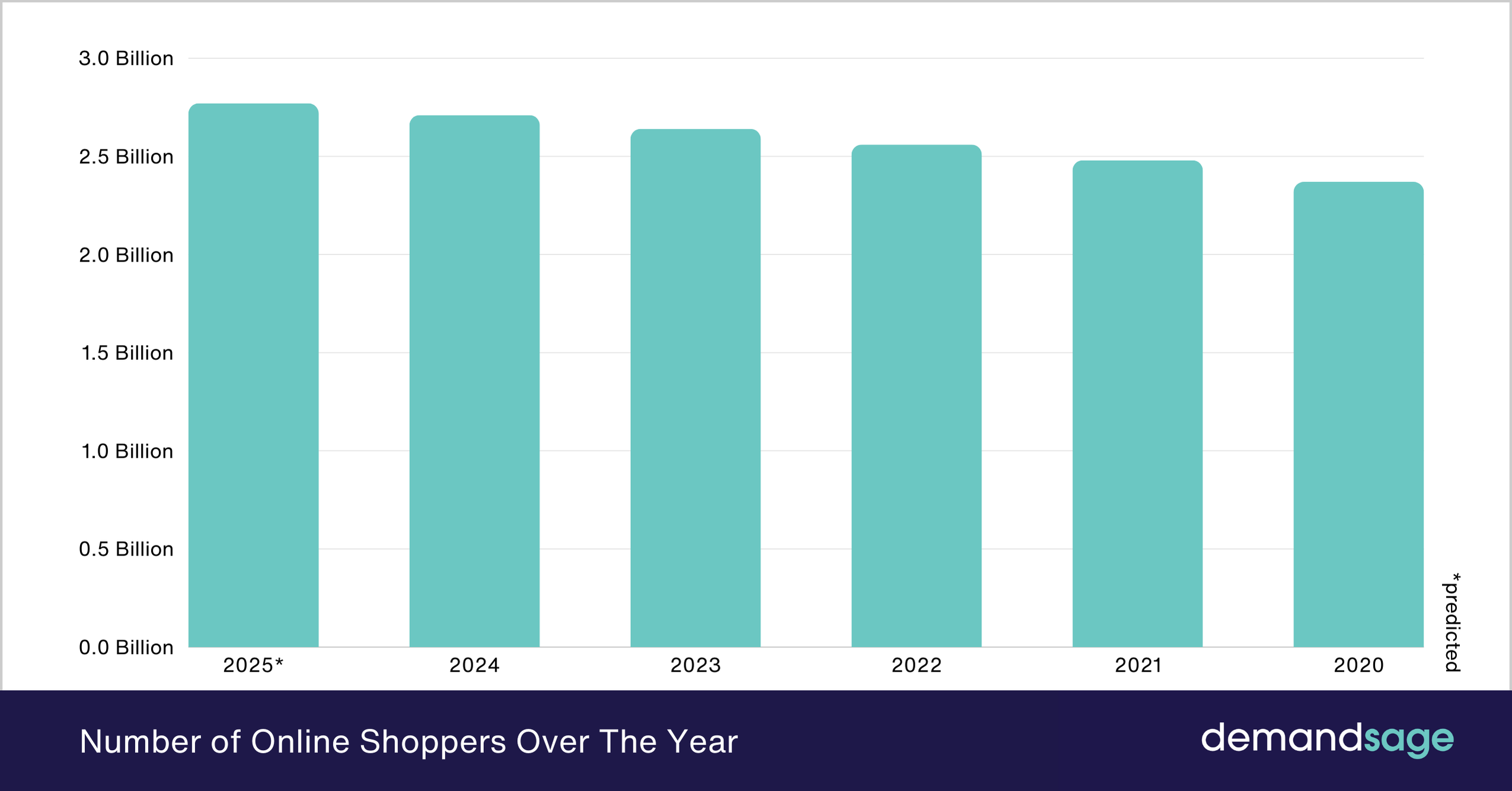
Here is a table displaying the number of online shoppers worldwide by year:
| Year | The Number of Online Shoppers | Year-Over-Year Change |
|---|---|---|
| 2025 | 2.77 billion | 2.2% |
| 2024 | 2.71 billion | 2.6% |
| 2023 | 2.64 billion | 3.1% |
| 2022 | 2.56 billion | 3.4% |
| 2021 | 2.48 billion | 4.8% |
| 2020 | 2.37 billion | 12.3% |
2. In the Middle East & Africa, 5.2% of online shoppers increased from 2022 to 2023, the most in all regions.
Worldwide, only 3.1% of online shoppers increased from 2022 to 2023. However some regions are experiencing an increase in online shoppers of more than 4%.
Online shoppers increased by 4.6% in Latin America.
This table shows the top regions by online shopper growth.
| Region | Growth of Online Shoppers |
|---|---|
| Middle East & Africa | 5.2% |
| Latine America | 4.6% |
| Asia-Pacific | 3.8% |
| Central & Eastern Europe | 3.2% |
| North America | 2.1% |
| Western Europe | 1.1% |
| Worldwide | 3.4% |
Source: Oberlo, eMarketer.
How Many People Shop Online In The United States?
3. 288.45 million people in the United States shop online.
That’s an increase of 5.6% compared to 259.06 million online shoppers recorded in the previous year.
Further, the number of online shoppers in the United States is estimated to reach 333.50 million by 2029.
Here is a table displaying the number of online shoppers in the United States.
| Year | No. Of Online Shoppers | Annual Change |
|---|---|---|
| 2029* | 333.50 million | +3.0% |
| 2028* | 323.77 million | +3.4% |
| 2027* | 313.01 million | +3.7% |
| 2026* | 301.87 million | +4.7% |
| 2025 | 288.45 million | +5.5% |
| 2024 | 273.49 million | +5.6% |
| 2023 | 259.06 million | +6.1% |
| 2022 | 244.23 million | +7.0% |
| 2021 | 228.19 million | +7.8% |
| 2020 | 211.67 million | – |
*Projected numbers
Source: Oberlo
Online Shopping Sales Statistics
Today, E-commerce is a multi-trillion-dollar industry worldwide. This section will explore all essential statistics related to online shopping sales.
4. Retail e-commerce sales are $6.42 trillion worldwide.
5. Over $419 billion in retail e-commerce sales have increased since the past year.
6. Industry experts also predict retail e-commerce sales will reach $7.89 trillion by 2028.
This table shows the retail e-commerce sales and total share worldwide from 2022 to 2028.
| Year | Retail e-commerce Sales | % Share of Retail Sales |
|---|---|---|
| 2028* | $7.89 trillion | 22.5% |
| 2027* | $7.38 trillion | 21.8% |
| 2026* | $6.88 trillion | 21.1% |
| 2025 | $6.42 trillion | 20.5% |
| 2024 | $6.01 trillion | 19.9% |
| 2023 | $5.58 trillion | 19.3% |
| 2022 | $5.09 trillion | 18.5% |
Source: eMarketer
7. The Asia-Pacific region generates the most retail e-commerce sales worldwide.
Over 54% of retail e-commerce sales come from this region.
North America is the second top region by retail e-commerce sales, with $1,144.99 billion in sales.
This table shows the top regions by retail e-commerce sales.
| Region | Total Retail E-commerce Sales |
|---|---|
| Asia-Pacific | $3,323.19 billion |
| North America | $1,144.99 billion |
| Western Europe | $694.59 billion |
| Latin America | $167.81 billion |
| Central & Eastern Europe | $141.90 billion |
| Southeast Asia | $89.67 billion |
| Middle East & Africa | $69.39 billion |
8. In the United States, $1,065.74 billion in sales comes from retail e-commerce.
The United States ranks 2nd in the total share of retail e-commerce sales worldwide.
At the top is China, with more than doubled retail e-commerce sales. In China, retail e-commerce sales are $2,784.74 billion as per the latest figures.
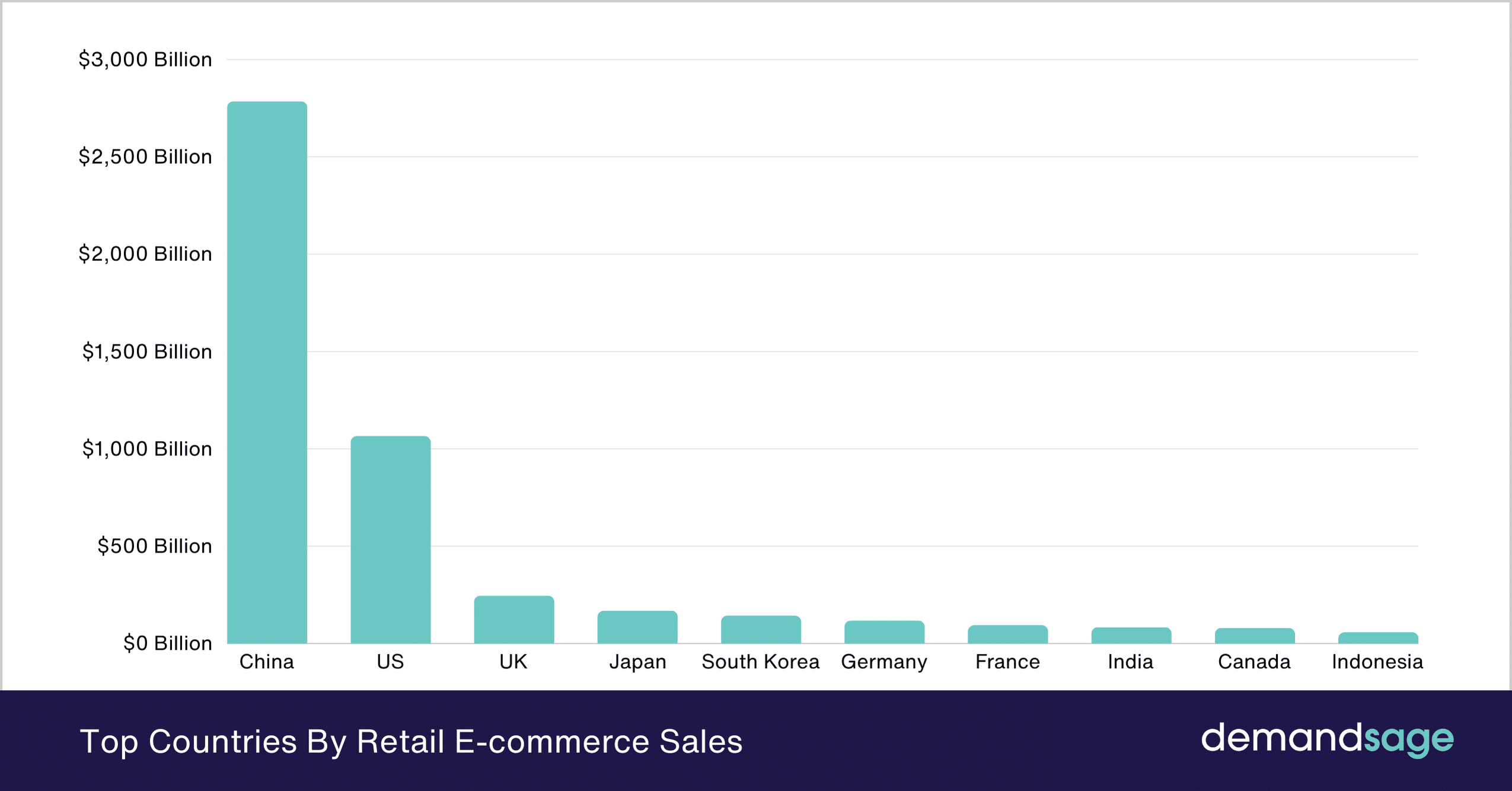
This table shows the top 10 countries by retail e-commerce sales.
| Top Country | Retail E-commerce Sales | Year-over-year Change |
|---|---|---|
| China | $2,784.74 billion | 11.9% |
| The United States | $1,065.19 billion | 15.9% |
| The United Kingdom | $245.83 billion | 4.8% |
| Japan | $168.70 billion | 2.7% |
| South Korea | $142.92 billion | 13% |
| Germany | $117.85 billion | 7.5% |
| France | $94.43 billion | 8.5% |
| India | $83.75 billion | 25.5% |
| Canada | $79.80 billion | 10.4% |
| Indonesia | $58 billion | 23% |
9. 20.5% of all retail sales come from e-commerce worldwide.
The share of retail e-commerce sales in the total retail sales is steadily increasing worldwide. It increased by 0.6% from 2024 to 2025.
In 2024, the retail e-commerce sales share was 19.9%. From 2022 to 2024, it increased by 1.4%.
By 2028, the share of retail e-commerce sales will be 22.5% worldwide.
10. Retail e-commerce sales growth is the highest in Southeast Asia, with 20.6%.
Globally, retail e-commerce sales growth is 12%, but the Southeast Asia region has the most retail e-commerce sales growth worldwide, which is 8.4% more than worldwide growth.
The second region with the most retail e-commerce sales growth is Latin America, which has a growth rate of 20.4%.
This table shows the top regions by retail e-commerce sales growth.
| Region | Retail E-commerce Sales Growth |
|---|---|
| Southeast Asia | 20.6% |
| Latin America | 20.4% |
| Middle East & Africa | 17% |
| Central & Eastern Europe | 16.1% |
| North America | 15.5% |
| Asia-pacific | 11.8% |
| Western Europe | 6.1% |
| Worldwide | 12.2% |
11. The Philippines has the highest retail e-commerce sales growth.
China contributes the most to retail e-commerce sales, but the growth rate of its retail e-commerce sales is less. Even China is not in the top 10 countries with the most retail e-commerce sales growth.
In second place is India, with 25.5% of retail e-commerce sales growth; in third place comes Indonesia, with 23%
The United States is in 10th place, with a 15.9% growth rate, but it comes second after China by retail e-commerce sales.
This table shows the top 10 countries by retail e-commerce sales growth.
| Top Country | Retail E-commerce Sales Growth |
|---|---|
| Philippines | 25.9% |
| India | 25.5% |
| Indonesia | 23% |
| Brazil | 22.2% |
| Vietnam | 19% |
| Argentina | 18.6% |
| Malaysia | 18.3% |
| Thailand | 18% |
| Mexico | 18% |
| The United States | 15.9% |
12. $1.137 trillion in retail e-commerce sales comes from the United States.
From $0.520 trillion in 2018 to $1.137 trillion in 2023, retail e-commerce sales increased by almost 120% in the United States.
By 2027, this sale will reach $1.72 trillion in the United States.
This table shows the retail e-commerce sales over the years:
| Year | Retail E-commerce Sales In The United States |
|---|---|
| 2027* | $1.72 trillion |
| 2026* | $1.545 trillion |
| 2025* | $1.392 trillion |
| 2024* | $1.256 trillion |
| 2023 | $1.137 trillion |
| 2022 | $1.040 trillion |
| 2021 | $0.959 trillion |
| 2020 | $0.817 trillion |
| 2019 | $0.598 trillion |
| 2018 | $0.520 trillion |
*Projected
As the data shows, online shopping is booming. If you’re a seller planning to capitalize on this trend, using Helium 10 Coupon Codes can make your startup journey more budget-friendly.
Mobile E-Commerce Statistics
Let us take a look at some crucial statistics associated with mobile commerce in this section.
13. Mobile e-commerce sales are $4.541 trillion worldwide.
Mobile e-commerce sales are increasing rapidly year over year. From 2022 to 2023, mobile e-commerce sales increased by $0.446 trillion.
In 2022 Mobile e-commerce sales were $3.643 trillion, which was $0.44 trillion more than in 2021.
Industry experts predict mobile e-commerce sales will hit $4.999 trillion by 2025.
This table shows mobile e-commerce sales worldwide from 2020 to 2025.
| Year | Mobile E-commerce Sales | Year-over-year Change |
|---|---|---|
| 2025* | $4.999 trillion | 10.1% |
| 2024 | $4.541 trillion | 11.1% |
| 2023 | $4.089 trillion | 12.3% |
| 2022 | $3.643 trillion | 13.7% |
| 2021 | $3.203 trillion | 17.7% |
| 2020 | $2.721 trillion | 29.2% |
*Projected
14. The share of mobile e-commerce sales is 66.5% of total e-commerce sales.
In total e-commerce sales, the share of mobile e-commerce is growing and continues year by year.
From 2022 to 2023, mobile e-commerce shares increased by 0.8%, which was 65.7% in 2022.
In 2020, the share of mobile e-commerce was 64.1%.
By 2025, the share of mobile e-commerce sales worldwide will be 67.6%.
This table shows the share of mobile e-commerce sales worldwide from 2020 to 2025.
| Year | Share Of Mobile E-commerce Sales |
|---|---|
| 2025* | 67.6% |
| 2024* | 67.1% |
| 2023 | 66.5% |
| 2022 | 65.7% |
| 2021 | 64.9% |
| 2020 | 64.1% |
*Projected
15. The Asia-Pacific region has the most mobile e-commerce share worldwide, with 79.9%.
In the Asia-Pacific region, almost 8 out of 10 sales come from mobile, which keeps this region at the top of retail M-commerce sales shares worldwide.
The second-top region is Middle East & Africa, with 66.4% of the share, while Southeast Asia is in third place, with 64.6%.
This table shows the world’s top regions by retail M-commerce sales share.
| Top Region | Share Of Retail M-commerce Sales |
|---|---|
| Asia-Pacific | 79.9% |
| Middle East & Africa | 66.4% |
| Southeast Asia | 64.6% |
| Latin America | 59.4% |
| Western Europe | 46.8% |
| Central & Eastern Europe | 40.3% |
| North America | 40.1% |
| Worldwide | 65.7% |
Source: eMarketer.
Social Media E-Commerce Statistics
There are 4.8 billion social media users, so focusing on social media marketing is essential. Let’s see all the vital statistics related to social media e-commerce.
16. Social commerce sales are $1.298 trillion worldwide.
Online shoppers spent $0.992 trillion on social media shopping in 2022, which continuously increases yearly.
Also, industry experts predict that by 2026, social commerce sales will hit $2.9 trillion.
This table shows the worldwide social commerce sales from 2022 to 2026.
| Year | Social Commerce Sales |
|---|---|
| 2026* | $2.900 trillion |
| 2025* | $2.221 trillion |
| 2024* | $1.698 trillion |
| 2023 | $1.298 trillion |
| 2022 | $0.992 trillion |
*Projected
17. 54.8% of Facebook users purchased from the platform at least once.
15.8% of Facebook users buy from this platform all of the time while 5.9% never buy anything.
20.6% of TikTok users always buy from the platform, and 48.7% of users buy sometimes.
This table shows the buying frequency of social media users by platform.
| Platform | All Of The Time | Sometimes | Rarely | Never |
|---|---|---|---|---|
| TikTok | 20.6% | 48.7% | 20.7% | 9.9% |
| YouTube | 16.6% | 47.7% | 24.1% | 11.6% |
| 16.4% | 55.8% | 20.7% | 7.1% | |
| 15.8% | 54.8% | 23.6% | 5.9% | |
| 15.4% | 37% | 33.4% | 14.3% | |
| 11% | 45.1% | 29.3% | 14.6% |
18. 50.7% of online shoppers say Facebook is the most popular social media platform for online shopping.
Facebook is the primary choice of online buyers, while Instagram is the second choice, with 47.4%.
Note: To know more interesting facts and data about Facebook, refer to our article on Facebook Statistics.
At the same time, 33.9% of buyers choose YouTube as their first choice for online shopping.
This table shows the popular social media platforms for shopping.
| Popular Social Media Platforms | Share Of Respondents |
|---|---|
| 50.7% | |
| 47.4% | |
| YouTube | 33.9% |
| TikTok | 23.9% |
| Snapchat | 18.8% |
| 18.5% |
Source: eMarketers, Forbes.
E-commerce Marketplace Statistics
This section will provide all the essential insights into the e-commerce marketplace.
19. In the United States, retail marketplace e-commerce sales are $384.57 billion.
From 2022 to 2023, retail marketplace e-commerce sales in the United States grew by 10.2%.
Also, retail marketplace e-commerce sales are forecast to reach $603.20 billion by 2027.
This table shows the retail marketplace e-commerce sales in the United States from 2023 to 2027.
*Projected
| Year | Retail Marketplace E-commerce Sales | Year-Over-Year Change |
|---|---|---|
| 2027* | $603.20 billion | 12.5% |
| 2026* | $536.06 billion | 12.2% |
| 2025* | $477.68 billion | 11.5% |
| 2024* | $428.30 billion | 11.4% |
| 2023 | $384.57 billion | 10.2% |
20. Retail marketplace e-commerce sales shares are 33.5% of total retail e-commerce sales in the United States.
The share of retail marketplace e-commerce sales is increasing steadily every year.
From 2023 to 2024, market shares of retail marketplace e-commerce sales will increase by 0.3%.
Also, the share of retail marketplace e-commerce sales in the United States is predicted to be 34.8% by 2027.
This table shows the share of retail marketplace e-commerce sales in total retail e-commerce sales from 2023 to 2027.
| Year | Share Of Retail Marketplace E-commerce Sales |
|---|---|
| 2027* | 34.8% |
| 2026* | 34.4% |
| 2025* | 34% |
| 2024 | 33.8% |
| 2023 | 33.5% |
*Projected
21. Amazon is the most popular e-commerce site in the United States, with a 37.8% market share.
Amazon’s market share is significantly more than its competitors. The second most popular e-commerce site is Walmart in the United States, with 6.3% of market shares.
Walmart is followed by Apple and eBay, with 3.9% and 3.5% of market shares, respectively.
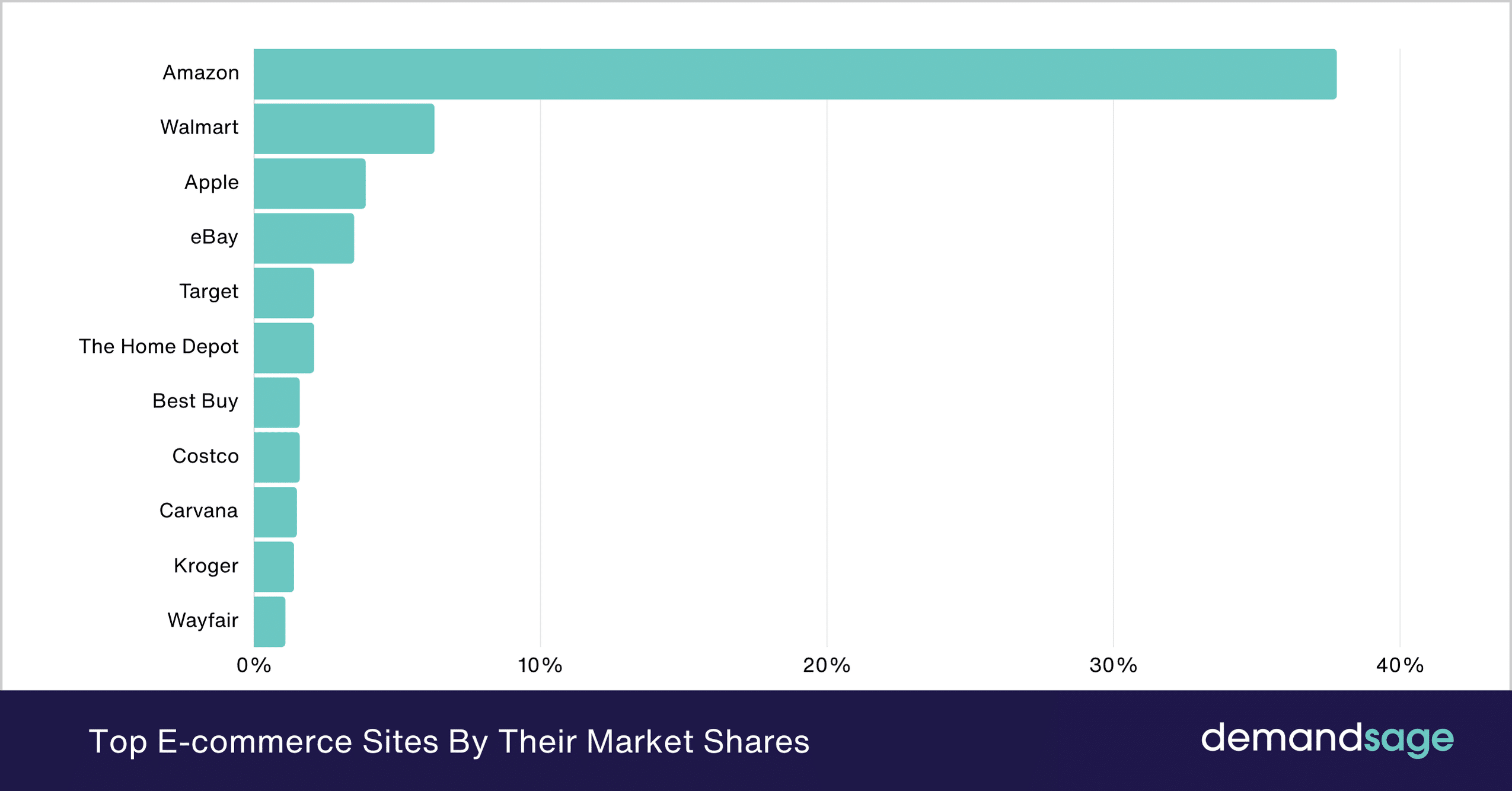
This table shows the top e-commerce sites in the United States by their market shares.
| Top E-commerce Site | Market Share |
|---|---|
| Amazon | 37.8% |
| Walmart | 6.3% |
| Apple | 3.9% |
| eBay | 3.5% |
| Target | 2.1% |
| The Home Depot | 2.1% |
| Best Buy | 1.6% |
| Costco | 1.6% |
| Carvana | 1.5% |
| Kroger | 1.4% |
| Wayfair | 1.1% |
22. Amazon is the leading online service provider worldwide by market cap, with a $857 billion market cap.
The second top online service provider is Alibaba.com, with a $233 billion market cap.
At the same time, with a $103 billion market cap, PinDuaDuo comes in third number.
This table shows the leading online service providers by market cap.
| Online Service Provider | Market Cap |
|---|---|
| Amazon.com | $857 billion |
| Alibaba.com | $233 billion |
| PinDuaDuo | $103 billion |
| Prosus | $91 billion |
| JD.com | $88 billion |
| Booking.com | $78 billion |
| Airbnb | $54 billion |
| Recruit | $51 billion |
| Uber | $49 billion |
| Shopify | $44 billion |
| Mercado Libre | $43 billion |
| JD health | $29 billion |
| Coupang | $26 billion |
| eBay | $23 billion |
| Doordash | $19 billion |
| $16 billion | |
| Chewy | $16 billion |
| Etsy | $15 billion |
| Delivery Hero | $12 billion |
| Wayfair | $4 billion |
Source: eMarketers, Oberlo, Shopify.
Consumer Behavior In Online Shopping Statistics
Let’s see all the critical statistics about consumer behavior in online shopping.
23. 31% of online shoppers buy at least once per month.
Most online shoppers fall under this group who buy products or services once per week, accounting for 818 million online shoppers.
24% of shoppers buy online once every two weeks, accounting for more than 633 million online shoppers.
This table shows the frequency of online shoppers buying online products or services.
| Frequency Of Buying | Share of Online Shoppers |
|---|---|
| Once Per Week | 20% |
| Once Every 2 Weeks | 24% |
| Once Per Month | 31% |
| Once every three months | 10% |
| 3-4 Times Every three months | 15% |
24. 37% of Gen Z shop online in the United States, while 39% shop in-store.
Overall, 42% of shoppers in the United States shop online, and 51% shop in-store. Of these online shoppers, 44% of millennials shop online.
This table shows the online and in-store shoppers by generation.
| Generation | Online | In-store |
|---|---|---|
| Overall all | 42% | 51% |
| Gen Z | 37% | 39% |
| Millennials | 44% | 49% |
| Gen X | 46% | 55% |
| Baby Boomers | 39% | 64% |
From the above table, we can say many buyers still prefer in-store shopping in the United States.
The in-store buying percentage is higher among Gen X and Baby Boomers than Gen Zs and Millennials.
25. 32% of online buyers buy products from the home & kitchen category.
Home and Kitchen is the leading category for small and medium-sized sellers on Amazon. Most buyers buy from this category.
The second top category is Beauty and Personal Care, with 23% of shoppers shopping from this.
This table shows the top categories of Amazon where online shoppers buy the most.
| Top Category | Share Of Shoppers |
|---|---|
| Home & Kitchen | 32% |
| Beauty & Personal care | 23% |
| Toys & Games | 20% |
| Clothing, Shoes & Jewelry | 18% |
| Health, Household & Baby Care | 17% |
| Sports & Outdoors | 16% |
| Arts, Crafts & Sewing | 15% |
| Books | 15% |
| Kitchen & Dining | 14% |
| Baby | 14% |
| Electronics | 14% |
| Tools & Home Improvements | 13% |
| Pet Supplies | 13% |
| Office Products | 12% |
| Garden & Outdoors | 12% |
| Grocery & Gourmet Food | 10% |
26. Globally, the Fashion category generated $1070 billion in sales.
Fashion is not the top category by the number of units sold, but it generated the most sales.
The second most sales-generated category is electronics, which generated $990 billion in sales, while the Toys, hobbies, and DIY category generated $720 billion.
This is followed by Furniture and Beauty, Health, Personal & Household Care, with $530 billion and $450 billion, respectively.
27. Gen Zs have $44 billion in buying capacity.
Gen Z is the more advanced technological generation. Almost 95% of Gen Z have smartphones and spend over 10 hours on them.
And 93% of parents of Gen Z say their child influences their online shopping. It is worth noting that Gen Zs will make up 40% of all shopping in a couple of years.
Source: Zippia, Tidio, Forbes.
Did you know? 41% of the shoppers look forward to purchasing most of their Christmas gifts online.
Online Shopping Trends
Let’s take a look at the viral online shopping trends in 2025.
Use Of Voice Assistance In Online Shopping
28. $40 billion in transactions have been made using voice-activated devices such as Google Home and Amazon Echo in 2022.
In 2017, around $2 billion in transactions were made through voice-activated devices. And these transactions increased by $38 billion in 2022, accounting for $40 billion.
29. There were 33.2 million Smart Speaker m-commerce shoppers in the United States in 2022.
Smart Speaker M-commerce shoppers make up 14.1% of all online shoppers in the United States.
From 2021 to 2022, 1.1 million Smart Speaker m-commerce shoppers increased.
This table shows the number of Smart Speaker m-commerce shoppers and their year-over-year growth in the United States from 2018 to 2022.
| Year | The Number of Smart Speaker M-commerce | Year-over-year |
|---|---|---|
| 2022 | 33.2 million | 60.4% |
| 2019 | 32.1 million | 31.1% |
| 2018 | 30.7 million | 19.1% |
| 2017 | 25.8 million | 4.5% |
| 2016 | 19.7 million | 3.5% |
30. 51% of shoppers use voice searches to research products in the United States.
Shoppers use voice searches for many online shopping-related activities.
36% of shoppers use voice searches to add products to a shopping list, and another 22% use them to purchase in the United States.
This table shows the use of voice searches for shopping-related activities.
| Shopping-Related Activities | Share Of Respondents |
|---|---|
| Research Product | 51% |
| Add to shopping list | 36% |
| To track package | 30% |
| To make purchases | 22% |
| To write reviews and give ratings | 20% |
| To contact support | 18% |
| To reorder items | 17% |
Source: eMarketers.
Impact Of Influencers On Online Shopping
31. Brands spent approximately $4.62 billion on influencer marketing in the United States.
In 2021, this spending was $3.69 billion, 33.6% more than in the previous year. And it increased by $0.93 billion.
In 2022, Brand spent almost $4.14 billion on influencer marketing.
32. 78.6% of marketers in the United States use influencer marketing.
Influencer marketing is one of the most essential strategies to increase your sales. Due to this, the percentage of marketers using influencer marketing is growing yearly.
In 2020, only 64.5% of marketers used influencer marketing, which increased to 78.6%.
Additionally, it is anticipated that 86% of marketers in the United States will use influencer marketing by 2025.
This table shows marketers who use influencer marketing in the United States from 2020 to 2025.
| Year | The Percentage Of Marketers Who Use Influencer Marketing |
|---|---|
| 2025* | 86% |
| 2024* | 82.7% |
| 2023 | 78.6% |
| 2022 | 74.5% |
| 2021 | 69.7% |
| 2020 | 64.5% |
*Projected
Source: eMarketers.
AI And Machine Learning in Online Shopping
33. AI-enabled ecommerce market valued at $8.65 billion in 2025, projected to reach $22.60 billion by 2032 at a 14.60% CAGR. (Precedence Research)
34. Companies using AI see an average revenue increase of 10-12%, with AI projected to enhance profitability by 59% by 2035. (Sellers Commerce)
35. 78% of online brands have already implemented AI in their stores.
36. 91% of consumers are more likely to shop with brands that provide personalized offers and recommendations. (Grid Dynamics)
37. 33% of ecommerce enterprises will include agentic AI by 2028, compared to less than 1% today. (Sellers Commerce)
38. Product recommendations can increase revenue by up to 300%, conversions by 150%, and average order value by 50%. (Monetate)
According to the report of Oracle, many e-commerce brands have already implemented AI tools or plan to in their businesses.
Additionally, 80% of marketing and sales leaders are using AI or plan to use it in the future.
Did you know that more than 34% of people prefer chatbots in the eCommerce sector? To know more interesting facts and data about Artificial Intelligence, read our article here.
39. 43% of decision-makers say AI will help in marketing in the future.
The use of AI and ML in e-commerce is increasing. Chatbots are the best example of this. 80% of consumers have used chatbots for online shopping.
Also, 34% of decision-makers say AI can help in the customer services area in the future.
This table shows the future areas of e-commerce where AI and ML can help businesses.
| Areas of E-commerce Businesses | Share Of Respondents |
|---|---|
| Personalization | 70% |
| Site Search | 54% |
| Forecasting | 52% |
| Marketing | 43% |
| Pricing | 38% |
| Customer Services | 34% |
| Sales | 28% |
| Fraud Prevention | 25% |
| Product Assortments | 19% |
| Delivery | 15% |
| Order Management | 15% |
| AI can not help | 4% |
| Other | 3% |
Source: Statista, Shopify, Soocial.com.
Did you know? The E-commerce fraud detection and prevention market is forecasted to reach $102.28 billion by the end of 2027.
Use Of AR And VR In Online Shopping
40. Globally, there are 97.1 million and 70.8 million users of AR and VR, respectively.
The number of AR and VR users is increasing continue yearly. In 2022, there were 89.4 billion AR users and 66.8 billion VR users.
It is projected that there will be 110.3 billion AR users by 2025.
This table shows the number of AR and VR users from 2020 to 2025.
| Year | AR Users | VR Users |
|---|---|---|
| 2025* | 110.3 million | 75.4 million |
| 2024 | 104.3 million | 73.7 million |
| 2023 | 97.1 million | 70.8 million |
| 2022 | 89.4 million | 66.8 million |
| 2021 | 80.4 million | 61.5 million |
| 2020 | 70 million | 50.7 million |
*Projected
41. 64% of online buyers say AR will increase their shopping experience.
Also, 64% of consumers prefer online shopping on AR sites, which account for $120 billion in sales.
Additionally, 66% of consumers are interested in using AR while purchasing.
AR is also helpful for brands. 64% of brands said AR improved their brand loyalty.
Source: Tech Jury, eMarketers.
Conclusion: 2.77 Billion People Worldwide Shop Online
Online shopping has revolutionized the retail and wholesale industry, offering buyers convenience and a wide range of options.
Currently, over 2.77 billion buyers worldwide make purchases online, and over half of these purchases are made from mobile devices.
Looking at the latest trends in online shopping, it is evident that the number of online shoppers and the eCommerce market will flourish further in the upcoming years.