Since starting my own digital marketing agency in mid-2015, I’ve tested more SEO tools than I care to admit. I’ve used free ones, freemium ones, expensive enterprise suites, and niche tools that promised to “change SEO forever.”
Over the years, I’ve also been forced to subscribe to tools not because I liked them, but because a client believed that tool was the source of truth for their website’s performance.
Fast-forward to 2026, and the stakes are much higher.
SEO is no longer just about ranking blue links. Digital marketing agencies today are expected to handle AI search visibility, generative engine optimization (GEO), technical performance, content systems, link authority, and reporting at scale, often with smaller teams and tighter margins.
And here’s the uncomfortable truth: Most SEO tools still haven’t caught up to how agencies actually work.
Many tools are bloated, slow, or built for solo marketers, not for agencies managing multiple clients, multiple sites, and multiple stakeholders. Others look impressive on the surface but fail where it matters most: accuracy, automation, and actionable insights.
So instead of listing every popular tool on the internet, I decided to update this article for 2026 with a very clear goal: help agency owners avoid wasting money on tools that don’t move the needle.
This list features only SEO tools that are genuinely worth paying for if you run a digital marketing agency.
Ground Rules for this List (Updated for 2026)
To make this useful for agencies (not hobbyists), I’m only including all-purpose SEO platforms that can handle the full lifecycle of SEO work across clients.
Every tool featured below must include all six essential capabilities required to run SEO at agency scale in 2026:
- Keyword research (including intent and opportunity analysis)
- Competitive research (to reverse-engineer what’s already working)
- Backlink analysis (monitoring, auditing, and link intelligence)
- Technical SEO audits (for scalable, repeatable fixes across multiple sites)
- Position tracking (reliable, client-ready reporting you can actually trust)
- AI search visibility (tracking and improving how your content appears in AI-powered search results like ChatGPT, Gemini, and other generative engines)
If a tool can’t help you with all six, it’s not an agency-grade SEO platform in 2026. It’s just a collection of features pretending to be one.
I’m intentionally excluding single-purpose tools like BuzzSumo, Ubersuggest, and Google Keyword Planner. They’re useful, but they’re not built to run an agency.
For example:
- Standalone tools add complexity instead of reducing it
- Keyword Planner is an Ads tool, not an SEO platform
- BuzzSumo is excellent for content discovery, but useless for audits or rank tracking
The tools listed below allow you to go from audit → insight → execution → reporting without duct-taping your workflow together.
If you find one tool in this list that fits your budget and your workflow, you’ve essentially found your agency’s SEO backbone.
So without further ado, here are the 6 best SEO tools for digital marketing agencies in 2026.
Note: This list focuses only on paid SEO tools. If you’re looking for free options, check out our guide to the best free SEO tools for quick wins and one-off tasks.
6 Best SEO Agency Tools: Summary
Below are our top 6 recommendations for best SEO software for agencies. For an in-depth look at each of these tools, refer to the next section.
Budget-friendly Choice
Use it if you want to do high-quality website audits and spend less time on SEO reporting.
Top Choice
Use it if your top priority is keyword research, competition analysis, and site audit.
Use it if your top priority is backlink analysis.
Use it if you have a smaller budget, but would still like a reliable SEO tool.
Use it for its phenomenal keyword research capabilities.
Use it if your top priority is optimizing your clients’ conversion rates.
Top 6 SEO Tools for Digital Marketing Agencies
Use it if you want to do high-quality website audits and spend less time on SEO reporting.
Price: Starts at $65/month (Start your 2-week trial)
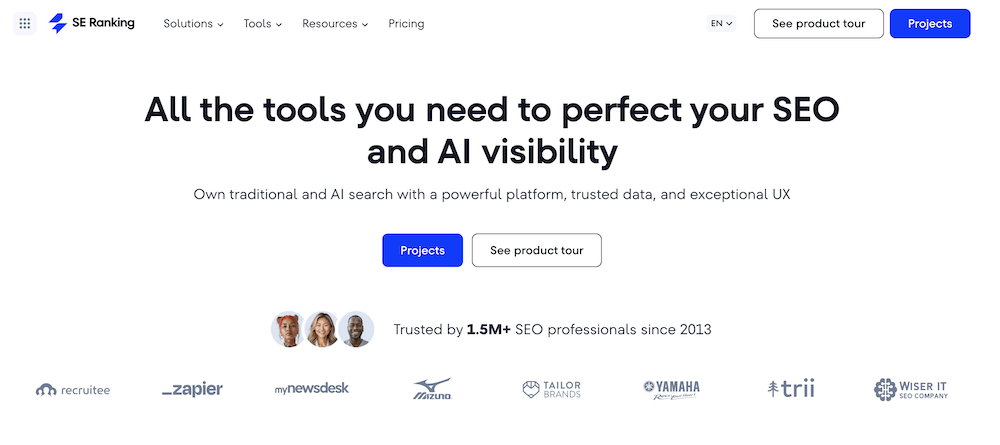
Almost every agency engagement still starts with an SEO audit, and SE Ranking remains one of the most reliable tools for that job in 2026. Its Website Audit breaks down a site into clear, actionable issues and highlights even small problems that can hold rankings back.
The audit checks over 110 parameters across 19 categories. Each issue is assigned a severity level, a clear explanation, and fix recommendations so your team can prioritize work fast. You can also customize audit settings for each client, which is useful when managing different industries and site types.
SE Ranking applies the same structured approach across its entire platform, including how it handles AI search visibility, which has become a non-negotiable for agencies in 2026.
For AI search, SE Ranking lets you track whether your pages appear in AI Overviews and generative answers, monitor brand mentions inside AI results, and compare your visibility against competitors. This gives agencies a way to report on AI search presence even when there is no traditional ranking or click data available.
For keyword research, the tool provides accurate SEO and PPC metrics, intent signals, and large keyword sets you can turn into content or campaign plans quickly.
For rank tracking, SE Ranking shows daily, non-personalized positions across locations and devices, alongside AI visibility signals for the same keyword set.
For backlink analysis, the Backlink Checker evaluates links using quality metrics like domain trust, anchor text, and link dynamics, making it easy to monitor growth or spot risks.
For competitive research, SE Ranking reveals competitor keywords, top pages, traffic sources, and paid strategies so you can reverse engineer what is working and replicate it.
Reporting is where SE Ranking really shines for agencies. You can create automated or manual reports using customizable templates, connect GA4 and Search Console, and white label everything with your agency branding.
Why agencies still use SE Ranking in 2026
- Website audits with clear priorities and fix guidance
- AI search visibility tracking for generative results
- Accurate daily rank tracking across locations and devices
- Keyword research with intent and opportunity data
- Competitive analysis for SEO and PPC
- White label dashboards and client-ready reports
- Cost-effective agency plans with extra seats and support
Side note: SE Ranking offers a dedicated agency pack with additional client seats, team training, and a personal manager, making it one of the most budget-friendly platforms that still meets modern SEO and AI search requirements.
Use it if your top priority is keyword research, competitive intelligence, technical SEO audits, and AI search visibility tracking.
Price: Starts at $139.95/month (Click here for a free trial)
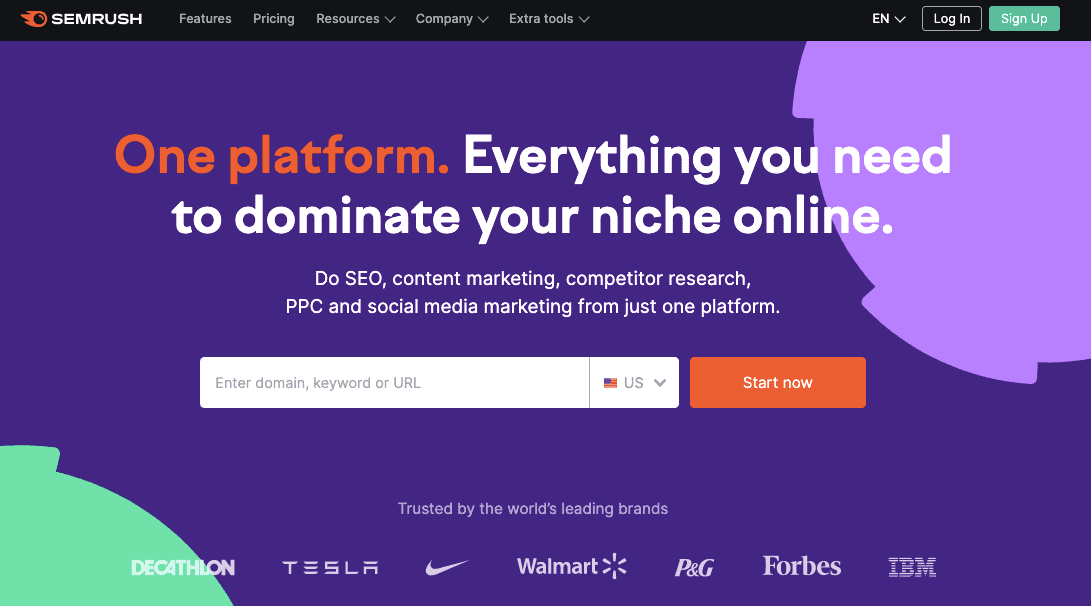
Semrush has been my go-to SEO platform since the early days of my agency, and in 2026 it remains one of the most complete SEO tools you can use to run client campaigns at scale.
Semrush is still best known for its keyword research and competitive intelligence, and that is where it continues to shine. If your client operates in a competitive space or is new to the market, ranking for high-volume keywords is rarely realistic. The smarter play is to find low-competition keywords with strong traffic potential and build authority from there.
The Keyword Magic Tool makes this process simple. You can uncover both head terms and long-tail keywords, filter by intent, difficulty, and competition, and quickly identify keywords that are actually worth pursuing. For most agency campaigns, the sweet spot remains keywords with low to medium volume, manageable difficulty, and clear intent.
Semrush also includes one of the most mature technical SEO audit tools on the market. The Site Audit tool scans websites at scale, flags critical issues, and prioritizes fixes so your team can move fast without getting lost in noise.
What makes
If you want a deeper look at how this works, check out my full breakdown of the Semrush AI Visibility Toolkit.
For agencies, this bridges the gap between traditional SEO and AI search, making
Why agencies still use Semrush in 2026
- Best-in-class keyword research and intent analysis
- Deep competitive intelligence for organic and paid search
- Technical SEO audits with clear prioritization
- AI search visibility tracking with the
Semrush AI Visibility Toolkit - Domain-level comparison for multi-competitor analysis
- Reliable rank tracking and long-term trend data
Use it if your agency prioritizes backlink intelligence, authority building, and competitor analysis.
Price: Starts at $129/mo
Ahrefs started as the best backlink analysis tool in the industry, and in 2026 it has evolved into a full AI-powered marketing and discovery platform. Today, agencies use Ahrefs not just to analyze links, but to understand demand, measure authority, and ensure their clients are discoverable in search and AI-driven results.
Backlinks are still Ahrefs’ strongest advantage. Its link index remains one of the largest and freshest in the world, which makes it the most reliable source for link intelligence, authority analysis, and competitive research. When agencies need to know who is winning, why they are winning, and where authority is flowing, Ahrefs is usually the first place they look.
But modern Ahrefs goes far beyond links.
In 2026, Ahrefs positions itself as a platform for search, AI, and beyond. Its tools now use AI to support keyword discovery, content research, site auditing, and competitive analysis. This helps agencies identify not just what ranks, but what gets discovered across traditional SERPs and AI-powered search experiences.
Site Explorer remains the core of the platform. It gives you a complete view of any domain’s backlinks, organic traffic, top pages, and keyword footprint. Agencies use it to reverse engineer competitors, find link opportunities, and identify authority gaps that need to be closed.
Keywords Explorer helps agencies uncover real demand, not just keywords. You get accurate search volume, difficulty, click data, parent topics, and intent signals that make it easier to plan content that actually performs.
Rank Tracker lets you monitor keyword performance across locations and devices, track progress over time, and send automated reports to clients without manual work.
Ahrefs also includes a Site Audit tool that scans websites for technical issues, prioritizes fixes, and helps teams maintain clean, healthy sites at scale.
For agencies in 2026, Ahrefs is no longer just a backlink tool. It is a discovery engine that connects authority, content, and visibility across both search and AI-driven environments.
Why agencies still use Ahrefs in 2026
- Industry-leading backlink index for authority and link intelligence
- Deep competitive research with Site Explorer
- AI-assisted keyword discovery and content research
- Reliable rank tracking across countries and devices
- Technical site audits with clear prioritization
- Fast, clean interface built for daily agency workflows
Side note: For a more in-depth comparison of features between
Use it if your agency prioritizes inbound marketing, content-led SEO, and tying search performance to revenue.
Price: Starts at $15/mo/seat
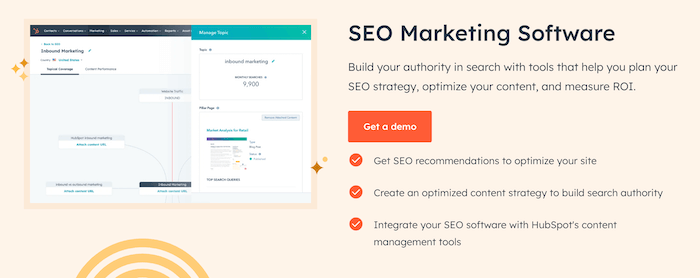
HubSpot’s SEO Marketing Software is not built for hardcore SEO specialists. It is built for agencies that want SEO to work as part of a larger growth system, not as a disconnected channel.
In 2026, HubSpot positions SEO as part of its broader Marketing Hub, where content, CMS, CRM, analytics, and automation work together in one system. For agencies managing inbound-focused clients, this integration is the real advantage, not advanced SEO data.
HubSpot’s SEO tools live directly inside its CMS and content workflows. Instead of working in separate tools, agencies get keyword guidance, on-page recommendations, and topic suggestions while creating or optimizing content. This makes HubSpot especially useful for teams that need structure and direction rather than deep SEO diagnostics.
The Content Strategy tool helps you plan topic clusters around search intent and authority, making it easier to build structured content that search engines and AI systems can understand. HubSpot also uses AI to recommend improvements, suggest topics, and identify gaps based on what already performs on your site.
From a reporting standpoint, HubSpot connects SEO performance directly to business outcomes. You can see how content drives traffic, conversions, and revenue, not just rankings. Google Search Console integration pulls impressions and clicks directly into HubSpot, removing the need for separate reporting tools.
HubSpot also plays well with AI-driven search workflows. Its content optimization, structured site architecture, and authority-building approach align well with how generative engines select and summarize sources, even though HubSpot does not offer standalone AI visibility tracking like
For agencies focused on inbound, content, and lifecycle marketing, HubSpot turns SEO into a system, not a checklist.
Why agencies still use HubSpot in 2026
- SEO tools integrated directly into CMS and content workflows
- AI-assisted content optimization and topic planning
- Topic clusters that improve authority and site structure
- Search Console integration for clean, unified reporting
- SEO tied to leads, conversions, and revenue
- No-code website builder for fast client launches
- Ideal for inbound and content-led growth strategies
Related: 15 Free HubSpot Tools and Resources Every Marketer Should Be Using
Use it if you have a smaller budget but still need a reliable SEO tool that covers all the essentials.
Price: Starts at $69/mo
Serpstat exists for one very clear reason: it gives agencies a functional, all-in-one SEO platform without enterprise pricing.
In 2026, most top-tier SEO tools start at prices that make sense only if you already have multiple clients or a mature agency. Serpstat fills the gap for smaller agencies, solo consultants, and early-stage teams that still need real SEO capabilities without paying premium rates.
Originally launched as a keyword research tool, Serpstat has evolved into a full SEO and PPC analysis platform. Today, it covers the fundamentals that agencies actually need to deliver results: keyword research, competitive analysis, site audits, backlink analysis, and rank tracking.
Serpstat’s keyword research tools are one of its strongest areas. You can generate keyword ideas, analyze search intent, explore related queries, and uncover long-tail opportunities that are easier to rank for. The Search Questions and Related Keywords reports are especially useful for building content clusters quickly.
The Site Audit tool scans websites for technical issues, groups them by priority, and gives you clear fixes, which makes it easy to use even if you do not have a dedicated technical SEO specialist on your team.
Serpstat also includes backlink analysis and competitor research, allowing agencies to see where competitors get links, which keywords drive traffic, and how difficult it will be to compete. The data is not as deep as
In 2026, Serpstat also leans into AI-assisted SEO workflows, including intent analysis, keyword grouping, and content ideation features that help speed up research and planning. It is not an AI search visibility platform, but it does help agencies work faster and more efficiently with limited resources.
For agencies that care about ROI, Serpstat remains one of the most cost-effective SEO tools on the market.
Why agencies still use Serpstat in 2026
- Affordable all-in-one SEO platform for small agencies
- Strong keyword research with intent and question analysis
- Technical site audits with clear priorities and fixes
- Competitive research for SEO and PPC campaigns
- Backlink analysis for link building and monitoring
- AI-assisted keyword grouping and content ideation
- Low learning curve for junior team members
Use it if you want a budget-friendly SEO tool with strong keyword research and basic AI search visibility tracking.
Price: Starts at $30.50/mo
Mangools has always been about making SEO simple, affordable, and fast. In 2026, it still does that, but it has also quietly evolved into a modern SEO and AI search visibility toolkit for smaller agencies and lean teams.
Instead of bloating the platform, Mangools keeps its focus on five tightly integrated tools: KWFinder for keyword research, SERPChecker for SERP analysis, LinkMiner for backlink analysis, SERPWatcher for rank tracking, and SiteProfiler for domain insights.
The flagship tool is still KWFinder. It remains one of the easiest ways to find low-competition keywords with real ranking potential. Agencies use it to plan blog content, landing pages, and supporting pages without needing deep SEO expertise. The keyword difficulty score is simple, reliable, and fast to act on.
SERPChecker helps you analyze the real competition behind any keyword. You can see authority levels, backlink strength, and SERP composition before committing resources, which saves time and prevents wasted effort.
LinkMiner and SiteProfiler cover backlink and domain analysis. They are not as deep as Ahrefs or
In 2026, the big upgrade is AI Search Watcher. Mangools now lets agencies track how brands appear in AI-powered search engines like ChatGPT, Gemini, Claude, and others. You can monitor AI mentions, compare visibility against competitors, and see how often your brand is referenced in generative answers. This gives agencies a simple way to measure AI search visibility without needing enterprise tools.
Mangools does not try to be everything. It gives you just enough SEO and AI visibility data to do the job well, at a price that makes sense when you are managing multiple small clients.
Why agencies still use Mangools in 2026
- Excellent keyword research with KWFinder
- Easy SERP analysis for realistic keyword targeting
- Affordable all-in-one SEO toolkit
- AI Search Watcher for generative search visibility tracking
- Simple backlink and domain analysis for small campaigns
- Clean interface with very low learning curve
- Ideal for lean teams and early-stage agencies
Related: Semrush vs Mangools: Which SEO Tool is Better?
Final Thoughts
So these are the six SEO tools I’d recommend to digital marketing agencies. Based on your top priority and budget, you can choose any of these 6 SEO tools:
Budget-friendly Choice
Use it if you want to do high-quality website audits and spend less time on SEO reporting.
Top Choice
Use it if your top priority is keyword research, competition analysis, and site audit.
Use it if your top priority is backlink analysis.
Use it if you have a smaller budget, but would still like a reliable SEO tool.
Use it for its phenomenal keyword research capabilities.
Use it if your top priority is optimizing your clients’ conversion rates.
You can also check out these free SEO tools to supplement your SEO efforts, but to get the best results for your clients’ SEO and PPC campaigns, you’ll need to invest in at least one of the above SEO tools.
Frequently Asked Questions (FAQs)
1. Why do agencies need premium SEO tools?
Agencies often manage multiple client accounts and need tools that can handle bulk analysis, reporting, and tracking. Premium SEO tools like
2. What are some key features to look for in an SEO tool for agencies?
Key features include keyword research capabilities, competitor analysis, comprehensive reporting tools, white-labeling options, integration with other marketing tools, scalability, and customer support.
3. What makes an SEO tool “all-purpose”?
An all-purpose SEO tool includes features for keyword research, competitive research, backlink analysis, technical SEO audits, and position tracking. These tools provide comprehensive functionality to handle a variety of SEO tasks.
4. Why are free SEO tools not included in this list?
The article focuses on paid SEO tools that offer comprehensive features for agencies. While free SEO tools can be useful, they often have limitations in features and scalability compared to paid options.
5. How do I choose the right SEO tool for my agency?
Consider your agency’s specific needs, such as the priority of SEO tasks (e.g., keyword research, site audit) and budget constraints. Also, think about the tool’s scalability and whether it offers features that can grow with your agency.
6. Can I use these SEO tools for a small or newly started agency?
Yes, some tools mentioned offer budget-friendly options and are suitable for small agencies or those just starting out. It’s important to evaluate each tool’s pricing and features to find the best fit for your agency’s size and budget.
7. Is it worth investing in a paid SEO tool?
Investing in a paid SEO tool can significantly enhance your agency’s SEO capabilities, providing comprehensive data, insights, and automation that free tools cannot match. Consider the potential ROI in terms of time saved and improved SEO performance for your clients.
8. How often should I use these SEO tools for optimal results?
Regular use of SEO tools is essential for monitoring your clients’ website performance, tracking rankings, identifying technical issues, and staying ahead of competitors. Weekly checks and monthly in-depth analyses are common practices among successful agencies.
9. Can SEO tools guarantee better rankings for my clients?
While SEO tools provide valuable insights and data to inform your strategies, they cannot guarantee better rankings due to the ever-changing nature of search engine algorithms. However, using these tools effectively can significantly increase your chances of improving your clients’ SEO performance.
10. What support can I expect from these SEO tool providers?
Most SEO tool providers offer customer support through tutorials, documentation, online chat, email, and sometimes phone support. Look for providers with robust support options to help you maximize the tool’s benefits.
11. How does the integration of SEO tools with other marketing software benefit agencies?
Integration allows agencies to streamline their workflows and consolidate data across platforms, making it easier to measure overall performance and ROI. This holistic view can lead to more cohesive and effective marketing strategies.
12. How often should agencies re-evaluate their choice of SEO tools?
Agencies should assess their tools at least once a year or whenever there are significant changes in their needs, the landscape of SEO, or the tools themselves. This ensures that they are always using the best resources to serve their clients effectively.
Editor’s Note: This article was first published on October 3, 2019 and has been updated regularly since then for relevance and comprehensiveness.
Related Articles