

This is an edited excerpt from Chapter 5 of Playful Design: Creating Game Experiences in Everyday Interfaces, published by Rosenfeld Media.
“Okay,” you say, “I’m ready.”
You’re a seasoned designer with a long history of creating compelling user experiences. You see the advantages that games can offer to UX design. You like (maybe even love) the idea of building an iPhone game to serve as a tour of a historic park, a social media game for Facebook to organise a political campaign, or a freestanding Flash game to teach basic physics on an educational website. You even have a rough concept of what that game might be like. You may be in a position to get funding for the project within your company or to pitch the idea to a receptive client. You want to start putting your ideas down on paper, get development under way, and speed toward launch.
That’s an awesome place to be. Vision and ambition are written into the opening lines of all success stories. But there are some risks to jumping in too quickly. Game development is very time-consuming and resource- intensive. It can be difficult to make a significant change in direction if you discover midway through development that some of your initial ideas aren’t translating into the great gameplay experience you had in mind.
So before getting started and running with it, you need a primer to point you in the right direction, to steer you clear of the most common mistakes, and to maximise your chances of success. This is the chapter for you. Though the challenges of building an enjoyable game shouldn’t be oversimplified, the 10 general guidelines I present here will at least help you refine your ideas and break through some of the common barriers that could otherwise hold back your design.
1. Games need to be games first
This point may sound too obvious, but it can be very easy to miss. And missing it is often the undoing of a well-intentioned design. You can design games to teach and persuade (as discussed later), but if such real-world objectives supersede meaningful gameplay, they will undermine your chances for success. First and foremost, a game needs to be enjoyed.
The Schwab MoneyWise It’s Your Life game has a noble mission: to convince people to save more money for retirement and other long-term objectives. Much like the original Game of Life board game, It’s Your Life presents players with a number of choices between spending or saving money over the course of a simulated lifetime (Figure 5.1). At the end, players get a letter grade to represent how well they did.
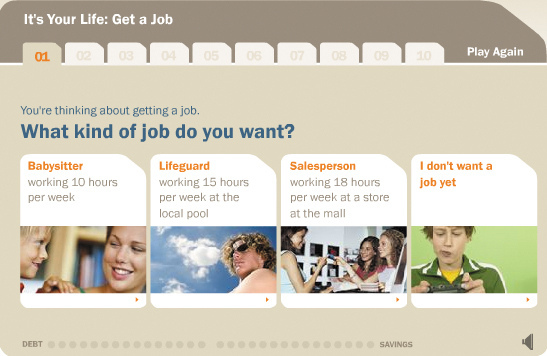
The problem is that the game’s designers were much more interested in hammering home their message than creating an actual game experience. If you want to win the game, then the right choice each step of the way is to save your money and not spend any of it. Ever. On anything. That means you can earn an A+, the highest possible score, if you:
- Skip college
- Never move out of your parents’ house
- Never get married
- Never have children
- Never travel or take any vacations
- Work indefinitely past age 65
- Die alone with lots of money and no one to leave it to
I’m sure the designers reasoned that people playing through the scenarios would elect to do valuable things with their lives, but they set up the game so that doing nothing with your life while saving vigorously is a sure way to win. Separating what people should do from what gets rewarded destroys the intended message. Even though It’s Your Life is packaged as a game, it isn’t committed to being experienced as a game.
2. Playtest, playtest, playtest
As much as we all know that testing is absolutely, completely indispensable in user interface design, I must stress (grammar be damned) that it is even more absolutely, completely indispensable when you’re designing a game. Even though every UX designer’s mantra is “test, test, test,” it’s still worth saying that you really must not neglect to playtest your game early and often.
The reason testing is so important in game development is that most video games are highly dynamic experiences. The flow of events changes from moment to moment, and each decision the player makes leads to a multiplicity of outcomes. Most games are also programmed with an element of randomness, so the same player never has quite the same experience twice. Multiplayer games throw even more unpredictability into the mix. As a result, the designer doesn’t directly control the actual gameplay, but instead controls only the underlying system in which the play unfolds. Without actually seeing the game in action, you cannot reliably anticipate how it will work. Mike Ambinder, an experimental psychologist at game developer Valve Software, puts it in scientific terms: “Every game design is a hypothesis, and every instance of play is an experiment.”
So, aren’t you fortunate to have a background in testing user experiences! Exploit it at every opportunity when designing your game. Grab your coworkers, your family, your friends – anyone who’s willing – sit them down with your game, and watch them as they play it. Don’t forget to play it yourself too! Be harshly critical. Do you enjoy playing it? When it’s over, do you feel like playing it again? Is it frustrating? Is it boring? Is it too hard to figure out what to do? I’ll go into more detail about game-specific testing methods in Chapter 8, but it’s important that you be prepared to put your game under the microscope again and again, and to adapt the design to make it more enjoyable.
3. Games don’t have to be for kids
Young people have much more leisure time than grown-ups, and many of us remember spending long periods of our childhood playing games. So it’s natural for us to associate games with kids. Video games in particular tend to have a juvenile image, and that’s not without reason: 91 per cent of kids under age 17 identify themselves as gamers, and they often have a lot of influence over which games a household purchases. Large segments of games are marketed toward children, and many of these games feature kid-friendly mascots like Pikachu or Mario. The link between childhood and video games is very real, so it’s not surprising that designers often decide to create games specifically intended to appeal to children.
But with a large market catering to them, kids also have the latitude to be very discerning consumers. Enormously sophisticated cross-media marketing campaigns pushing big-budget titles already crowd one another out, so you’ll find that just getting a young game consumer’s attention is a tremendous challenge. Kids often select a popular title specifically because they feel it will raise their social status among their friends. Because these games can be very demanding of their time, your idea must offer a pretty compelling value proposition for them to sacrifice minutes or hours that could otherwise be spent with their pastime of choice. Kids take games seriously, and you can’t assume that they’ll play your game just because it’s a game.
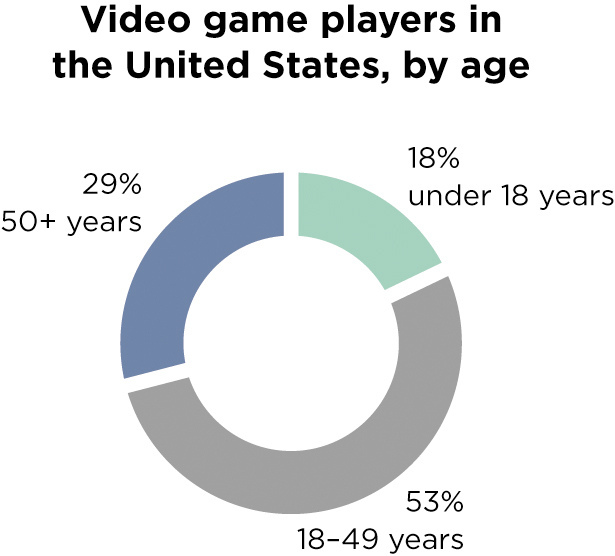
We also know that kids are only the minority of people who play video games. As I mentioned in Chapter 1, 82 per cent of gamers are over age 18, and 29 per cent are 50 or older (Figure 5.2). 3 Grown-ups can also be more receptive to playing games outside of the mainstream, and they have more disposable income to spend on games (if you plan to sell it to consumers).
This is not to say that kids couldn’t make up a portion of your game’s audience. But if your game is clearly intended for young children, as announced in breathless starbursts reading “Hey kids!” and “Super cool!” you will turn off the larger segment of gamers. So consider targeting your game to an older age group while keeping it accessible to a broad range of ages.
4. Action can be boring
Call of Duty: Modern Warfare 3 is an amazing action game. It unfolds over dozens of hours, during which you encounter waves of enemies exquisitely balanced against the resources available to you, interact with teammates controlled by artificial intelligence (AI) algorithms, and fight through varied locations that provide no unfair advantage to either you or your targets. And it’s all wrapped up in an engaging and complex story line. Call of Duty also took years to make and a team comprising dozens of designers, artists, and engineers at a cost of many millions of dollars. You’re probably not making Call of Duty.
It’s very difficult to sustain adrenaline-pumping excitement for very long. If you do choose to make an action-based game on a small scale, you’ll find that you’re limited to very simple and short-lived scenarios that resemble games of the arcade era. Racing a car. Throwing a basketball. Shooting a spaceship. Taken on their own, these types of experiences tend to grow tiresome quickly. In comparison to the enormously sophisticated action games that people have access to today, they’re just plain dull.
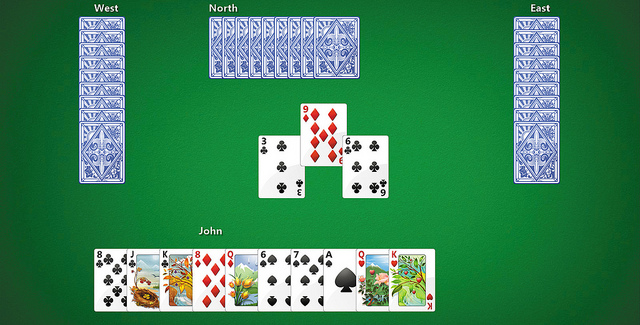
Consider what makes a game intrinsically interesting. You’ll find a lot of creative opportunity in games that make the player think through interesting choices instead of executing twitch responses. The card game Hearts, for example, is all about choices (Figure 5.3). Which three cards should I pass to my opponent? Should I play a high card or a low card? Should I break hearts, or hold off to see if someone else does it first? If I play clubs one more time, will someone else stick me with the queen of spades? Should I try to shoot the moon, or will that prove self-destructive? Each choice is reevaluated from one trick to the next, depending on the changing conditions of your hand and on new information about what other players have already done. Even though Hearts can be a fairly long game, it can hold players’ interest without any laser blasters or lava levels.
You can also invite players to apply their imaginations to the game. Mafia Wars, a Facebook game with more than 3.5 million monthly active players,4 merely alludes to street crime while showing none of it (Figure 5.4). To pull off a bank heist, you just select “Bank Heist” from a menu of criminal activity. The game immediately responds with a message that you completed the job successfully. In place of real-time action and 3D graphics, players are offered choices about which jobs to take, how to invest their earnings, and which personal attributes to develop. There’s no limit to what can be achieved in a player’s imagination.

5. Fit the game into the player’s lifestyle
Think about the real-life contexts in which people will play the game. Start the design process by asking:
- Who are your players?
- How much time do your players have to give to the game, and how much of that time would they actually be willing to give?
- Will your players need to take a break from the game and continue it later?
- How will your players access the game?
- Where will your players be when they’re playing the game?
- What kind of hardware, software, and Internet access will be available to your players?
The answers to these questions can help you set requirements for the duration of play, the way the game will be accessed, and the technical requirements of players’ computers and devices. Use playtesting to figure out whether your estimates are working out.
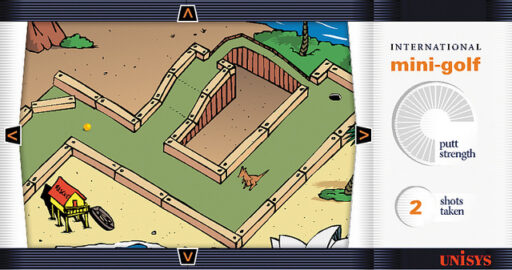
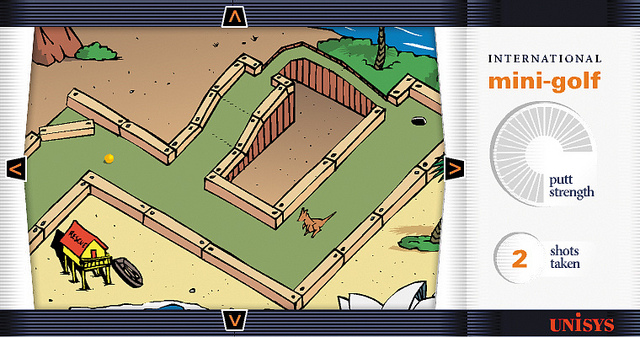
For example, Unisys developed a series of online games for the company’s sales team to send to customers as holiday greetings. Customers would receive a link by e-mail to an online holiday card with a personal message from the salesperson. The card would then open out into the game, branded with the Unisys logo (Figure 5.5).
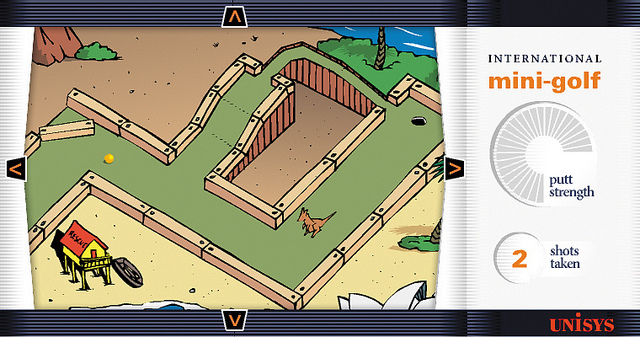
Because the players were adults receiving these e-mails at work, the games couldn’t require a significant investment of time to reach the end, so all of them were designed to last less than five minutes. And because many players would be accessing the game while sitting in standard office cubicles, where they typically would have their computer speakers turned off to avoid irritating coworkers in their shared space, the limited sounds in the games were not essential to the experience.
Contrast that design with Metal Gear Solid 4: Guns of the Patriots, a home console game containing cutscenes (in-game movies during which gameplay is suspended) that can run as long as an hour and a half and can come at any time during play (Figure 5.6). Games like this ask for a real commitment from their players, and they are appropriate only for audiences with abundant leisure time.

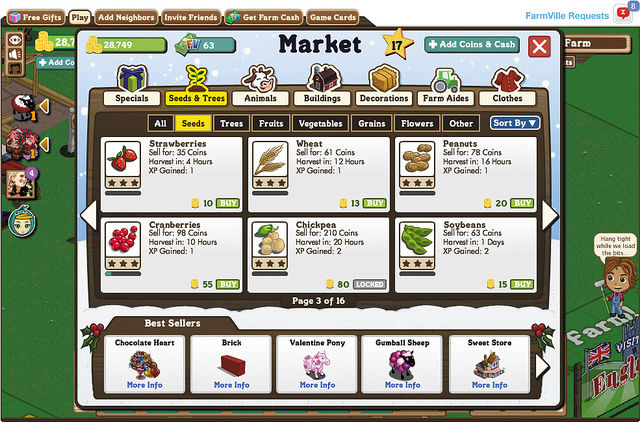
FarmVille cleverly makes itself adaptable to the player’s lifestyle. Players need to dedicate only a few minutes to it at a time, during which they can plant seeds for crops that take different amounts of real-world time to harvest. Raspberries take just two hours, so they’re useful when the player can check in several times in a single day. Eight-hour pumpkins fit in well just before and after a workday. Crops like artichokes take four days to harvest – better for players who can check in only now and then. The player is asked for some commitment, as fully grown crops that are left unharvested for too long wither and cost the player gold coins. But the staggered growth rates allow the time commitment to be on the player’s own terms (Figure 5.7).
6. Create meaningful experience
Players have to apply their time, their concentration, and their problem-solving abilities to the challenges your game throws at them. There should be a point to these efforts, a payoff for their investment. When the game ends, players should come away feeling that the experience was meaningful.
For the game to be a meaningful experience, players need to have a sense of control over the outcome. If players win or lose, does that prove anything about their skill, knowledge, or cleverness? Or does it all just come down to a coin flip? Many games involve some element of randomness, putting parts of the experience beyond the player’s control. A random element adds interest to the game by putting the outcome in doubt. But a meaningful game at least gives players a hand in tipping the odds in their own favor.
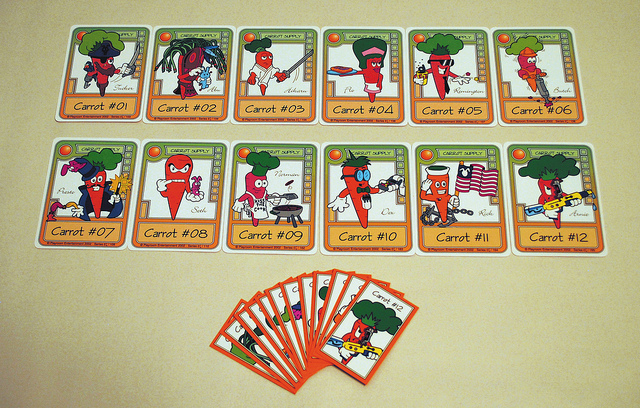
A great example is the card game Killer Bunnies, in which success is ultimately determined by a card picked randomly from a deck (Figure 5.8). The player who holds the match for that card (the “magic carrot”) is declared the winner. No player has any control over which card is picked; it’s a completely random selection. But the gameplay does give players some control over which matching cards they hold. Players compete for carrot cards over the course of the game, and shrewd players will work to hold the greatest number of them before the game is over. Even for the players who don’t win, the game says a lot about their mastery of the strategy, tolerance for risk, and skill at reading other people. Players come away from the game knowing that they had control over their chances of success, which makes the experience meaningful.
7. Don’t cheat
Because video game rules are enforced inside the black box of the computer’s circuitry, there’s a particular temptation for designers to take shortcuts by letting the game cheat. Giving the system more information or control than the player has, for example, can be a simple way to build challenge into a game. Power in a video game is unbalanced between the computer and the player, and the player has no way of challenging the computer or holding it to account. Don’t be tempted to cheat. It’s a bad design choice because, first, people will be able to tell what’s happening (oh yes, they will); second, cheating is a serious offence in games, and players have an instinctive revulsion to it.
Suppose you’re designing a blackjack game that matches a player against a computerised dealer. As a designer, you need to write a script to control the dealer’s actions. You want the dealer to be a little hard to beat but not impossible. One easy way to create challenge would be to let the script choose which card from the deck is drawn next. You then program the dealer to pick a card that will either win or lose, and put in a randomising function so that two out of every three times it picks a winning card. This strategy also creates an easy way to allow players to change the difficulty, so that on a harder setting the dealer will pick a winning card four out of every five times, while on an easier setting it wins just one out of every three. Since the deck of cards displays facedown on-screen, how would anyone even know that you’re cheating?
After playing the game a few times, you’ll see how (Figure 5.9). The dealer will do seemingly irrational things, such as hitting on 20 and magically drawing an ace. The deck will not seem random, because certain cards will tend to show up early and others will show up only after those preferred cards have been drawn. After several playthroughs, these patterns will become painfully obvious. Although the player can’t catch the computer in the act of cheating, these telltale artifacts are hard to cover up. When players realise that a game is cheating, they’ll make the ultimate winning move by turning it off.
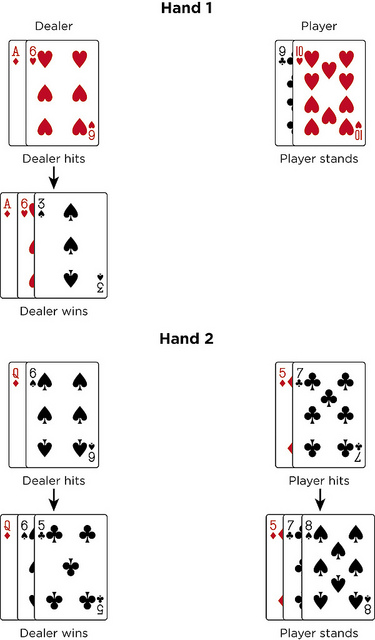
A better approach is to build a simple, rules-based AI. Don’t be too intimidated by the idea of building an AI; ultimately it’s just a computer program like any other. In this case, all you need is a line of code that tells the dealer to hit on 16 and stand on 17. The important thing is that the computer is subject to the same rules as the player. Make things work the way they look like they should work. If you show a deck being shuffled, randomly pick the full sequence of cards and put it into an array that can’t be changed. Don’t let the AI know what card is coming up next, or what cards are in the player’s hand. Don’t abuse the inherent advantage you have as the game designer.
8. Skip the manual
The best way to convince people a game is worth playing is to let them jump in and try it out for themselves. You can take people’s decision to open a game as the clearest possible signal that they’re in the mood to play, not to sit and read about how to play. Relying on written instructions presented at the beginning of every new game only creates a barrier to entry at the very time you want to be most accommodating of players. Instructions can also become a crutch, used to justify unconventional and unintuitive choices in the interface. Finally, game instructions can be very difficult to follow. Each game interface introduces a new vocabulary and a new set of controls. These things can be difficult to picture abstractly outside the dynamics of gameplay.
So the best place to teach people how to play a game is right there, inside the game itself. Tutorials have become one of the most familiar patterns in games. Minimalist, just-in-time instructions are even better (Figure 5.10). Ask yourself, “What’s the smallest amount of information the player needs to make the first move?” Then provide nothing more than that; you can get to the second move when the time comes. Play is learning. If people are interested in the game, they’ll be motivated to fill in the blanks themselves by playing it.
And keep in mind that if your game needs robust instructions for people to play it, this may be a warning sign in and of itself. Your game may be too complex, and some simplification may be in order.
9. Make the game make sense
Players need to understand why things happen in the game to feel that they’re in control of it. Your skills as a UX designer will be very valuable here, because this point is fundamentally about the intuitiveness of the gameplay. In game design, building a sensible experience relies on some key understandings between the designer and the player.
When players lose, it should be clear why they lost. If it’s not, then players won’t be able to get better at the game by avoiding the same mistake in the future. If this happens repeatedly, players will begin to feel that they’re being unfairly punished.
When players win, it should be clear why they won. If not, then it’ll be hard to replicate the victory. A win that doesn’t make sense can also cheapen the experience, leaving players feeling that the game’s standards weren’t that rigorous in the first place.
Every effect should have a clear cause. When something happens, players should be able to understand why it happened. Foldit, discussed in Chapter 1, is a wonderful example of game mechanics applied to a real-world problem. The relationship between cause and effect, however, is often unclear in the game. Twisting a protein’s side chain can create a conflict, but twisting a similar one in a similar way can earn you points. Trying to figure out why these actions have different results can be tremendously frustrating.
The object of the game should be clear. Players need to know what they’re working toward. A clear goal gives structure and meaning to the experience. It allows players to formulate strategies and gives them a reason to engage with the game. From the start and throughout every moment of play, players should be aware of their ultimate objective.
Players should always know what actions are available. At every moment, visible or aural cues should be provided to let players know what they can do. Adventure games, a popular genre in the 1980s, were plagued by failures of basic intuitiveness, because they often forced players to guess at what arcane actions might be available. Using a blue key to open a blue door makes sense to most people; using your athletic supporter as a slingshot to knock out a guard (as was required in Space Quest II) really doesn’t.
10. Make it easy to try again
When you’re down in the weeds constructing your game’s mechanics, it’s easy to focus on the ideal case in which players play straight through from beginning to end. It makes sense to author a game as a continuous narrative, with a beginning, a middle, and an end. But thinking of your game in those terms also risks losing sight of how it will actually be experienced in the real world. Remember to step back and think about the game as a discontinuous and iterative experience.
When a player loses, it should be easy to cycle back into the game and try again, instantly and effortlessly. Even large commercial games with multimillion-dollar development budgets make the common mistake of forcing a lengthy loading screen into that anxious space between a loss and a second attempt. Stretching that space of time to the second, third, or twentieth go-round inevitably tries the player’s patience. Games such as Braid and Prince of Persia: The Sands of Time have taken a clever route around this problem, allowing players to rewind time to a safe point before the losing moment.
Think, too, about the amount of work the game asks players to invest in it, and whether players would be frustrated if they lost and had to start all over again. This alone could be enough to make some players decide it’s not worth returning to the game. Consider giving players the option to save their progress.
Think about giving players incentives to play the game again after they’ve completed it. Some common ways of doing this include:
- Simple performance yardsticks, such as the ratings on a carnival strength test
- Collectables and achievements earned throughout the game, and a tally of how many the player has managed to obtain
- Score tracking and online leaderboards
- Periodic releases of fresh content
- New features and privileges that become available only on successive playthrough
When people replay a game, they’re signaling a personal appreciation for its design. Tracking the number of times people replay is one of the best general measures of your game’s success.
Play to your strengths
These 10 guidelines will help you get started, but plenty of challenges lie ahead as you set about designing and developing your game, and you’ll need to learn how to manage them as they come up. One last piece of advice is to play to your strengths. If you have a background in the design of conventional user interfaces, by all means use the skills and techniques that arise from it. Wireframing, user testing, rapid prototyping, storyboarding, flow diagramming, and other core skills all translate well to game design and can help you pull through the inevitable rough patches. When a game design issue has you confounded, trust your instincts and ask how you would handle a similar problem if you weren’t designing a game. More often than not, you’ll find that you can point yourself in the right direction.
This is an edited excerpt from Chapter 5 of Playful Design: Creating Game Experiences in Everyday Interfaces, published by Rosenfeld Media. Please use the discount code NETMAG12, good for 20% off all products purchased from Rosenfeld Media.