
Geert, 46, has been unable to work for several years due to his weak heart. With his disability benefit, he is just getting by. Last week, he underwent heart surgery. Everything went well, but now he has to wait eight weeks until the start of the rehabilitation programme. Geert feels somewhat helpless during this period. Due to the care staff shortage, he is offered an eHealth help tool to guide him during this period. But he does not find it easy to use, so he soon abandons the tool.
A growing gap
“Geert is not the only one in a situation where he isn’t able to use an eHealth tool,” says Jasper Faber, PhD candidate at the TU Delft | Faculty of Industrial Design Engineering (IDE). “People with a low social economic position (SEP) live on average seven years shorter than people with a high SEP. Due to lack of help or knowledge, they get sick faster and enter the healthcare system earlier. The gap further widens due to less technical skills to work with digital tools.”
In search of practical info
During their literature review on the gap between eHealth applications and people with low SEP, the researchers discovered something curious. Isra: “While we came across an abundance of general information, there was a striking lack of specific insights that could help professionals fine-tune and better tailor eHealth interventions to the low SEP group.”
To fill the knowledge gap, Isra involved experts in her research. Think medical professionals, psychologists, project staff, developers. “I asked 28 professionals about the promoting and hindering factors when developing a tool,” she says.
Meanwhile Jasper delved into the world of the user. “Designers bridge the gap between people and technology. That is why I visited community centres in Rotterdam South for two years to get to know the people there, build trust and involve them in my research. It was a two-way street. In exchange for their insights, I organised community activities. During the COVID lockdowns, for instance, I introduced the Ommetje app, which challenges you to move outdoors. Those who participated got a home workout kit.”
The introduction of this simple app proved a great success, confirming the researchers’ suspicions. “This group is very positive about tools that can help improve health. Most would like to live long and healthy lives. Contrary to the stereotypical images that sometimes circulate.”
A living site
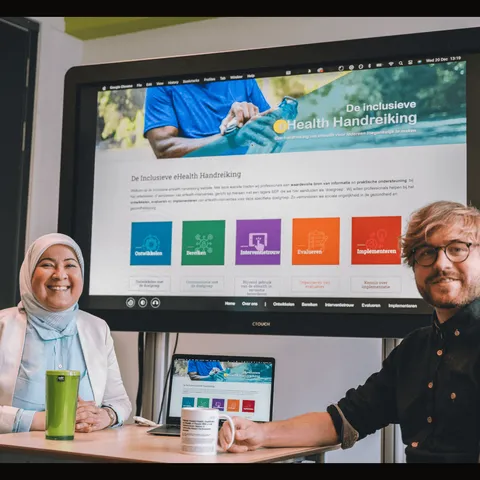
“Now we want to further develop the website,” Isra says. “For instance, there should be more concrete examples, more ‘how-to’s’ in it. It should be a living website. It is very motivating that everyone we worked with recognises the health gap between population groups and wants to do something about it. That is why we will continue working on this project, because we sincerely believe that we can make a positive contribution.”