


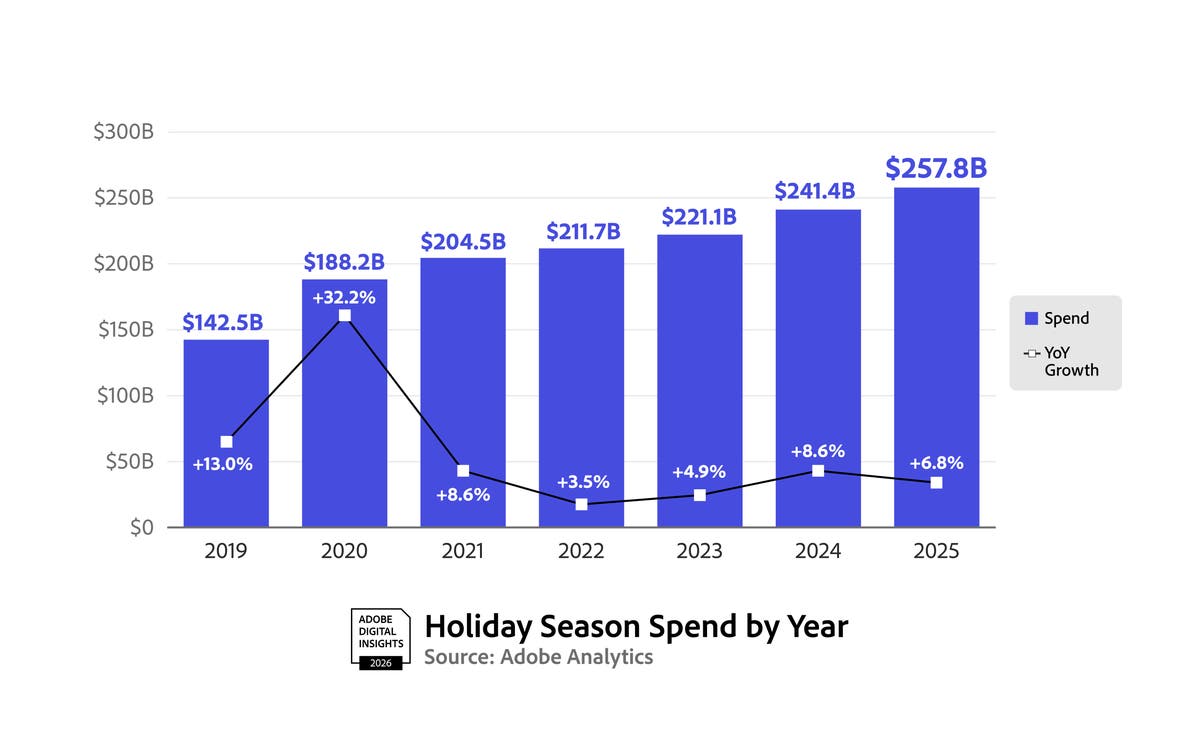
Record holiday season online, propelled by a strong Cyber Week
Consumers spent $257.8 billion online from Nov. 1 to Dec. 31, up 6.8% year-over-year (YoY) and setting a new record for e-commerce. 25 days saw consumers spend more than $4 billion in a single day (a significant jump from 18 days in 2024). Mobile shopping hit a new milestone, with the majority of online transactions (56.4%) taking place through a smartphone this season (up from 54.5% in 2024); Mobile shopping was highest on Christmas Day (Dec. 25), driving 66.5% of online sales (vs. 65% in 2024), followed by Thanksgiving Day (Nov. 27) at 61.6% mobile share (vs. 59.3% in 2024).
Record online spending this season was bolstered by a strong Cyber Week (the five days from Thanksgiving to Cyber Monday), which brought in $44.2 billion online overall, up 7.7% YoY. Cyber Monday remained the biggest e-commerce day of the season (and year), driving $14.25 billion in online spend, up 7.1% YoY. Cyber Monday growth was outpaced by Black Friday ($11.8 billion, up 9.1% YoY), as consumers embraced earlier deals. On Thanksgiving Day, consumers spent $6.4 billion online, up 5.3% YoY.
Competitive discounts pushed consumers to ‘trade up’
Strong discounts this season drove resilient consumer demand online. Shoppers found great deals in electronics, where discounts peaked at 30.9% off listed price (vs. 30.1% in 2024), as well as toys at 29.6% (vs. 28%), apparel at 25.1% (vs. 23.2%), televisions at 24.3% (vs. 24.2%), computers at 23.4% (vs. 22.8%), sporting goods at 20.3% (vs. 19.5%), appliances at 20.2% (vs. 19.2%) and furniture at 18.8% (vs. 19%).
Deals this season also drove consumers to purchase higher-ticket items in categories such as electronics, sporting goods and appliances—propelling e-commerce growth as a result. This season, the share-of-units-sold for the most expensive goods increased by 20% compared to the rest of the year. Within categories, this figure was up 56% in electronics, 55% in sporting goods, 38% in appliances, 34% in personal care products and 29% in tools.
Generative AI-powered chat services and browsers have become an integral tool for consumers to find deals and research products. This season, traffic to retail sites from generative AI tools (shoppers clicking on a link to a retail site) increased by 693.4% compared to the year prior. On Cyber Monday, AI traffic to U.S. retail sites increased by 670%. While the base of users remains modest, the uptick shows the value AI can deliver as a shopping assistant. These services were used most in categories including video games, toys, appliances, electronics and personal care products.
“This 2025 holiday season, consumers embraced generative AI more than ever as a shopping assistant in their purchasing decisions,” said Vivek Pandya, lead analyst, Adobe Digital Insights. “Competitive discounts and flexible payment options like Buy Now Pay Later also contributed to driving record spend of $257.8 billion throughout this holiday season.”
Buy Now Pay Later (BNPL) hits $20 billion milestone
Usage of the flexible payment method hit an all-time high this holiday season, contributing $20 billion in online spend, up 9.8% YoY and representing $1.8 billion more than the last season. Smartphones are the device of choice for consumers leveraging this flexible payment method, driving the vast majority (82.2%) of BNPL purchases this season. Additionally, Cyber Monday was the biggest day on record for BNPL, crossing the $1 billion milestone ($1.03 billion, up 4.2% YoY). In an Adobe survey of over 1,000 U.S. consumers (conducted Nov. 2025), respondents said they were most likely to use BNPL for electronics, apparel, toys, and furniture purchases.