
If you want to start your own online store, there are many things you need to consider. How will you create an online store, for example? You need to know on how to start an online store: from registering a website and buying products, to keeping inventory, to selling online and promoting your ecommerce business.
Content:

Software to create an online store with
In order to launch an online store, you need to use ecommerce software or an online store builder. These software providers usually offer an ecommerce template in which you can drag and drop features that you want to use.
Take some time to do your research, make use of the free trial options and compare the different providers that are available. Which features should be included in your software? Can your store grow easily or expand internationally with this solution? Three popular ecommerce software providers for European retailers are:

With no technical knowledge required, Webador’s user-friendly drag-and-drop website builder is ideal for launching your own online store. Easy to use steps make it easy to customize your site yourself. Next to stores also perfect for a small business website, portfolio or event pages.
- starter friendly: drag and drop, no coding needed
- hosting and traffic included in plans
- simple interface with help and tutorials
- more than 300.000 European users
- based in Eindhoven, The Netherlands
- hosted by Google Cloud

Create your own online store yourself with 100+ themes and a complete app store. Shopify also connects well with marketplaces, socials and dropshippers. The software is technically fully SEO-optimized. Has its own cloud infrastructure in Canada, although EU stores are hosted in EU by Google.
- international market leader (millions of transactions per day)
- supports more than 175 countries worldwide
- sell on socials and marketplaces
- advanced features and customization options
- popular app store with extensive extra functionality
- EU-stores hosted in EU by Google Cloud
Cloud based ecommerce software for small and medium retailers. You build and manage an online store with hosting, templates, payments, and basic SEO included. Focus is on simplicity, UK and EU sales, and fast setup without technical skills.
- built in templates and themes
- one subscription, everything included
- fast setup without technical skills
- supports European VAT rules
- UK and EU market focus
- founded in 2002, based in the UK

With over 700,000 users, Wix is one of the most popular solutions for SMEs worldwide. Easily create your own online store yourself, or choose one of more than 500 ecommerce designs from the software itself.
- flexible content first focus
- generates your website with AI
- built in seo tools
- app market with extra features
- headquarters in Tel Aviv, Israel
- hosted on multi-cloud services (AWS & Google Cloud)

With the hosted software from Strikingly, you are able to build your own website for free. A drag and drop functionality makes it easy to edit all the available sections. Its ecommerce tool ‘Simple Store’ allows you to turn your website into an online store and connect it to PayPal or Stripe.

Ecwid allows users to create a free online store within minutes. Instead of free trials, users can keep using the software for free for as long as they like. The software offers a lot of integrations that helps users sell on multiple channels, such as social media.

Sell online with an open source ecommerce platform. It has more than 300,000 users worldwide. The software is free to download and offers templates, modules and add-ons. Most of those do cost money.

Lightspeed eCommerce is a cloud-based solution to build an online store with. The software is extra convenient for omnichannel retailers. It enables them to manage in-store and online inventory, view all customer information and analyze multi-channel sales data, all in one system.
An e-commerce platform from Germany. It offers both open-source and commercial versions. The platform supports extensive customization, headless commerce, and API-based integrations. Shopware is modular, suitable for B2B and B2C webshops, and widely used across Europe.

BigCommerce is an open SaaS platform. It is built for integrations, including a WordPress integration, and allows you to work with the apps, agencies and technologies you prefer. Users get a free trial period of one month when you picking a plan.
The choice of your online shop’s key product range will strongly impact which software you should take. Most people who want to create an ecommerce store already have some experience, for example on eBay, Vinted or Facebook. If you have no idea which products you want to sell, you should decide this first.
Which products will you sell online?

The core of every online store is, of course, the products. The type of items you sell determines your business model. For example, do you want to sell larger items? And will you store those in your own warehouse? Can you afford them to be stored there, even if you sell less than expected?
Another option is to start with products from a dropshipping supplier, who directly sends them to your customers. This means that you will not have to store any items, as you are not buying in any stock. Examples of platforms for new sellers are:
The b2b platform Orderchamp is full of wholesalers for retailers with low purchase thresholds and minimum orders. Signing up is free. Larger retailers often use the platform to find great additions but small boutiques and concept stores can really find a total offering here.
- 7000+ true European brands
- low minimum order values
- options for exclusive partnerships
- tools for catalog, order, and pricing management
Large platform that offers over 100M+ products from European and United States suppliers, including fashion, beauty, and lifestyle products. You get fast delivery, branded packaging, private label options and unique print-on-demand solutions. Suitable for both dropshipping and wholesale.
- beginner-friendly
- suppliers from Europe and the United States
- branded packaging and private label options
- offers a strong Shopify integration
- strong product research tools
For 67 dollars a year, Salehoo gives you access to a database of more than 8,000 wholesalers, almost half of which deliver on a dropshipping basis. If you search carefully, you can also find a nice little wholesaler for Spanish dresses or Italian shoes or skirts here.

The Italian wholesaler B2B GRIFFATI offers several designer brands, including some exclusive fashion brands from Europe. With the dropshipping-plugin of Sync2Fashion you can easily add the products into your Shopify-store on, without the need for a warehouse or logistic management.

Trusted Belgian wholesaler supplying retailers and wholesalers for 15+ years. Extensive product range, dropshipping across Europe. Same-day shipping worldwide. Next-day delivery to BE and NL, 2-5 days to other EU countries. No subscription fees. Reliable, fast service with full tracking.

Ankorstore is a French b2b marketplace that connects brands and creators with online retailers all over Europe. The b2b ecommerce platform is active in Germany, Belgium and Spain. It has a customer base of 15.000 brands and 200.000 retailers.

The Faire platform features brands and wholesalers for retailers from North America and Europe. Both large and small online retailers can go here to complement their assortment in, for example, jewelry, clothing or home accessories.
Will you import your products or buy them locally?
How and which products you sell is a major factor in your chances of success. For example, importing items from China may sound easy, but local regulations often apply and require substantial paperwork. Starting with an EU supplier can make it easier to begin or to stay in close contact with your manufacturer.
Where do you store your products?

If you know which products you want to sell and where to buy them, you will need a place to store these items. Most small online business owners start out with buying goods at a wholesale price and then store them at home. When sales go well, they buy more and eventually start renting a warehouse storage space.
But when things are really starting to lift off, you could look at other solutions. Another company can store and send your orders for you. This is called ecommerce fulfillment. There are businesses specialized in doing this: storing and fulfilling orders for others. Large marketplaces like Amazon, for example, also offer such fulfillment services. Again, do your research and try comparing several e-fulfillment service providers to see which one suits you best.
Another company can store and fulfill the orders.

How will you send your orders?
When you know which items to sell and you have found a place to store them, it is time to ship them. You might already know how to send a parcel. What if you receive a massive amount of orders? Shipping costs can become quite high if you have to pay for each seperate parcel with a courier.
Picking and packing each item can also take a lot of time, especially when your business is becoming popular. How will you ship tons of items to customers across the country, or maybe even abroad? Look at parcel deliverers or couriers that offer a fixed monthly rate for sending out parcels.
Do you want to send packages with DHL, GLS, UPS and specialist carriers? Or use different carriers per country or size or weigth of the package? Sendcloud specializes in logistics software for online stores.
How will your customers pay you?

An important part of the buying process is accepting payments. Your customers need to pay for your products! But how will they do this? You need to offer several payment methods on your checkout page.
You could offer just one payment method, but this isn’t customer friendly. Because every customer is different: some like to pay with PayPal, others want a website to accept credit cards. Some like to pay beforehand, while others only want to pay when the goods have arrived. Dutch ecommerce laws even oblige online retailers to offer at least one payment method that gives customers the opportunity to pay after receiving the goods.
‘Before your first sale, you will need to sort out payment methods for your website.’
The easiest way to list multiple payment methods on your ecommerce site is by enlisting a payment provider. They have contracts with several payment methods and services, which makes it easy to integrate them into your sales channels. These providers are also able to process online payments in a secure way, so that you will not have to worry about receiving your money.
Looking for a European payment processor? Try Mollie! You only pay for successful transactions, so no minimum costs, lock-in contracts or hidden fees. Sign up now!
How do you attract potential customers?
A business can not survive without attracting customers, as they are the ones buying your products and thus giving you your revenue and, hopefully, your profits. But how do online businesses attract customers?
You can start by notifying your family, friends, relatives, and colleagues about your website, but you can also start by spreading the news through social media marketing. This can both happen organically or with paid posts.
Hopefully, you will even attract some repeat customers. Make sure that your website is intuitive, so that visitors can easily find your product categories and check out.
Start driving traffic
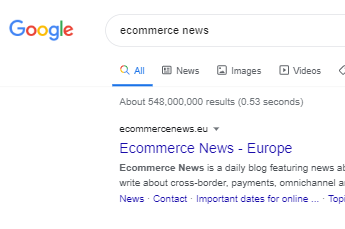
One of the bigger challenges for online stores is to gain visitors by being visible in search engines like Google. Again, this can both happen organically, with search engine optimization (SEO), or with paid posts. This is called search engine advertising (SEA).
Increasing your store’s visibility in Google is quite a challenge and thus a chapter on itself. But software and content play a huge rol in that. Therefore, it does not hurt to check if your software is built according to the guidelines of Google. If you write your own content, read up about the basics of SEO and SEA as well.
When you have visitors, the next step is to turn them into paying visitors. You need to convert visitors into customers. This is called conversion rate: the number of visitors who do something you want (in this case: buy something) out of the total number of visitors. On average, an online shop has a conversion rate between 2 and 4 percent. This means that if 100 people visit an online shop, 2 to 4 of them leave the shop while having bought something.
On average, an online shop has a conversion rate between 2 and 4 percent.
The business structure
You also need to make a decision about the type of business you want to start. Will it be a sole proprietorship, a private limited company, a public company, a partnership or something else? This decision will influence your taxes and liability.
For example, in the Netherlands a sole proprietor can claim various tax allowances, making a part of your profit tax-free. The profit made by a private limited company is subject to corporation tax, which is a significantly lower rate than income tax.
As a sole proprietor, you are liable for your company debts.
As a sole proprietor, you are personally liable for your company debts. If you operate your own business as a private limited company the company assets and your private capital are separate.
Which domain name will you use?
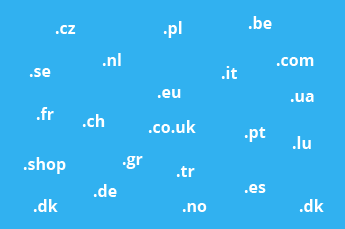
Now, after choosing your software, products and business model, comes the most fun part! What is going to be the name of your website? And which top level domain (the abbreviation after the dot) will you use?
Will it be a .com website, a .eu website or maybe some local ‘TLD’ like .fr (for France), .de (Germany) or .co.uk (the United Kingdom)?
Is your business cross-border proof?
With regards to the business and/or domain name, try to find one that, one day, can also work in other countries and different languages. If you start your business in the Netherlands, for example, under a very typical Dutch name it may be hard to enter another market in Europe.
Try to find a business name that also works in other countries, in case you will launch an online store abroad.
Know the local rules

It’s important to know how to start with an online store, but it’s also very important that you know all of the rules that apply to you in the country you’re based in.
For example, do you need to be registered at the local chamber of commerce if you want to start an ecommerce store? Can you be based in another country? If so, what extra rules apply then? How should you charge a sales tax?
VAT rules in the EU
When you begin an online store located somewhere in the EU and you ship goods (and services) to other EU member states, you need to pay a sales tax, or VAT (value-added tax). Consumers pay it as part of the product price and as a retailer you pay it to the authorities. This makes it an indirect tax.
If you are going to sell cross-border, you should look into the VAT rules within the EU. If you are based within the EU and make less than 10.000 euros with cross-border sales, you are allowed to charge the VAT rate of the country you are situated in to all customers you ship to. They only need to fill in their local tax return forms.
Find out which VAT rules you need to follow.
You have launched your online store… now what?

Your online store is up and running after choosing the right software, buying and storing products, setting up an online marketing strategy and gaining traffic through search engines and social media. Congratulations! But now what?
Now, it is important to keep it going. Do not sit still. Do not get distracted by your first revenue. Keep investing. Keep adapting. Keep improving. Try to find the bottlenecks in the customer journey. On which pages do visitors leave your website most often? How can you prevent this from happening?
Try to find new ways to promote your shop. Try to pump up that very important conversion rate. And what does your online store do after sales have taken place? How can you make sure that customers buy something again?
Frequently Asked Questions
Below you can find some frequently asked questions about how to start an ecommerce business. Hopefully the answers will help you get started with launching and running your online store!
What do I need to start an online business?
As you may have read above, there are plenty of things you need to think of when you want to launch a store online. Basically, you will need:
- products to sell (you can stock them in your warehouse or sell and ship them through dropshipping)
- software on which your online store runs
- knowledge about (local) rules that apply to online retailers
Furthermore, in order to run a successful online store, you will need to optimize your ecommerce website with unique product descriptions, clear product photos, great landing pages and of course interesting products and prices! And don’t forget the efforts you need to put in good marketing. You can have the best online shop in the world, but if no one in your target audience knows about it, you will not generate sales…
How much does it cost to run an online store?
Running an online store does not have to be expensive. You can use a free trial or even use commercial ecommerce software for free (as long as you don’t sell more than X items). And there os also open-source software which you can download for free and host on a server.
If you choose dropshipping, it does not cost thousands of euros to have your online store filled with all kinds of products. That is because you only pay for products that your customers order. And if your selling price is higher than your purchase price, you will have a good profit margin.
But, running a great online store is a different ball game. If you want to have success with your online store, you will have a hard time achieving this without making some serious investments. Investments in your software, your marketing, your products, et cetera.
How do I find products to sell online?
A good starting point if you want to know how to find products to sell online might be a wholesale platform or marketplace. Here you can get inspired by what is offered and directly contact the wholesaler of vendor.
Maybe these vendors also have products that you had not thought about yet! Also, check out the dropshipping suppliers in Europe.