



The global chatbot market is estimated at approximately $15.6 billion in 2026 and is projected to reach $46.6 billion by 2029. Most deployments fail. The bots that last are built for a single specific task and perform it better, faster, or more cost-effectively than a human agent can at scale.
We compiled a list of 25 successful chatbot examples from different applications and business use cases.
Chatbots for general use
Chatbots can act as digital friends and entertainers:
1-DeepSeek R1
DeepSeek attracted global attention in early 2025 by training competitive frontier models at a fraction of U.S. competitors’ costs. The widely cited $5 million figure covered only pre-training compute. When R&D, hardware, and infrastructure are included, independent estimates put the total above $1 billion. What the case actually demonstrated was that U.S. export controls on advanced chips had not stopped China from building state-of-the-art models. The architectural workarounds developed by DeepSeek are widely replicated.
2- GPT-5
Unlike previous generations, GPT-5 does not require users to select a model for a given task. A built-in router decides in real time whether to send the query to a fast, lightweight model or a slower reasoning model, based on how complex the question is. GPT-5.2 Thinking, the current top-tier variant, benchmarks above human expert level on GDPval, a set of knowledge work tasks spanning 44 occupations.
For chatbot builders, the practical change is that hallucination rates have dropped significantly: with web search enabled, GPT-5 responses contain roughly 45% fewer factual errors than GPT-4o, and GPT-5 Thinking contains 80% fewer errors than o3. GPT-5 is free for all ChatGPT users; Plus subscribers get higher usage limits and Pro subscribers get unlimited access.
3- Microsoft’s XiaoIce
XiaoIce launched in China in July 2014 and logged 500 million conversations within three months. After spinning off from Microsoft in 2021 it reached a $1 billion valuation. Two metrics indicate traction: the average conversation ran 23 turns, longer than typical human-to-human exchanges on the same platform, and the average user messaged it more than 60 times per month. In controlled tests, participants failed to identify it as a bot for an average of 10 consecutive minutes.
The engineering behind this involved indexing over 7 million public Mandarin conversations to produce natural-sounding responses, adding image recognition so the bot could engage with photos, and building entity-relationship tracking so it remembered context across a conversation thread.
- Fluid, natural-like speech, enabled by text mining: As anyone who frequently interacts with bots can tell you, it is rare to find a natural-sounding bot. The Microsoft team had to achieve this in Mandarin, which is more difficult to tackle than English, because meaning in Chinese is more often implied by nuance and context versus grammatical structure. To address this, Microsoft team indexed over 7 million public conversations on the web.
- Image recognition: XiaoIce understands images which allows her to interact in a richer way with users.
- Context understanding: XiaoIce understands context and relations between entities, as demonstrated below:

XiaoIce understands that movie has a setting, and that a star has a relationship with a director. Source: Microsoft Research Blog
Figure 1. Xiaoice demonstrates understanding of context.
4- Amazon Q at Availity
Availity, a healthcare IT company, integrated Amazon Q Developer into its IDEs and dashboards in early 2024. Within months, 33% of new code was AI-generated, and 31% of Q’s suggestions were committed directly. A Risk Assessment Bot ran 12,600 automated security scans, cutting release reviews from hours to minutes. Data-research tasks across AWS data lakes run twice as fast after engineers moved to natural-language queries.
5- Replika.ai got 30 million registered users worldwide
Replika surpassed 30 million registered users by August 2024. On the regulatory side, Italy’s data protection authority fined the company €5 million over data handling, and an FTC complaint has been filed over marketing practices.
The chatbot is designed to mimic human interactions, providing users with a more engaging and lifelike experience. However, common utility tasks such as setting alarms or ordering food are intentionally excluded, which users often cite as a major limitation.
Figure 2. Replika’s advanced AI chatbot mode
6- Character.AI
Character.AI reached 40 million downloads and 20 million monthly active users, with 1.7 million downloads in its first week. Users can create and interact with more than 18 million AI personalities. Google hired the co-founders and signed a technology licensing deal; the company was valued at over $5 billion at the time.
The platform has faced serious safety incidents. A U.S. lawsuit linked a teenager’s death to an unmoderated interaction on the platform. The American Psychological Association called for regulatory oversight of AI apps marketed as mental health tools, raising concerns about platforms that lack clinical validation. Character.AI responded by adding parental controls and session time limits.
7- Microsoft 365 Copilot saves Lumen Technologies
Lumen Technologies deployed Microsoft 365 Copilot organization-wide and measured the outcome: Copilot-generated meeting and email summaries recover roughly 4 hours per seller per week, which Lumen calculated as approximately $50 million in annual productivity value.
Customer service chatbots
8- Zoho SalesIQ
LambdaTest is a cloud platform focused on continuous quality testing, helping developers and testers with faster web, mobile, and visual testing. They aimed for a rapid response time under 60 seconds to meet users’ urgent needs. To achieve this, they implemented Zoho SalesIQ, which integrates with Zoho CRM and Desk. SalesIQ’s chat widgets, canned replies, and bots enabled customer engagement, while Zoho CRM provided vital customer data.
The result was a 40% increase in operator efficiency and faster support responses. GPT interaction helped redirect queries to the right department automatically.
Figure 3. LambdaTest’s performance increase with Zoho SalesIQ
9- Tidio boosts eye-oo revenue by €177,000
In late 2023, the multi-brand eyeglasses retailer Eye-oo, based in Italy, transitioned from Shopify Chat to Tidio live chat with Lyro AI flows.
- This switch generated an additional €177,000 in income and resulted in a 25% increase in overall sales after a year of implementing cart recovery and product recommendation flows.
- There was an 86% reduction in first-response time (from 2–5 minutes to about 30 seconds) due to Lyro automatically capturing 1,305 leads and resolving 82% of 2,233 support inquiries.
Any small e-commerce business evaluating chatbots can leverage a lightweight AI layer to boost six-figure revenue and decrease wait times without the need to hire more staff.
Education Chatbot
10- ChatMTC at MITPT AI
The Martin Trust Center for MIT Entrepreneurship sought a single system to answer questions using its documents, help desk content, and video library, without creating new sources. MIT built ChatMTC on CustomGPT’s platform. The bot cites the specific MIT resource behind every answer and is blocked from generating responses outside that knowledge base.
Healthcare chatbots
11- Dr. A.I. already makes recommendations like a Doctor
HealthTap Launches AI-Powered Patient Interviews Using GPT-4 to Enhance Telemedicine Visits
Figure 4. HealthTap Dr AI app’s interface
11. Dr. A.I. by HealthTap
HealthTap’s Dr. A.I. runs a structured patient interview before each telemedicine visit using GPT-4. It reads symptoms, asks follow-up questions, and cross-references stored patient data to route the case to the right specialist. Recommendations range from self-care to urgent care escalation. Responses are drawn from a physician-verified database rather than open-ended generation.
Therapist chatbots
12- Woebot, a free therapy chatbot
Woebot was developed by Stanford clinical psychologist Alison Darcy and launched as an app. A study of 70 college students showed measurable depression reduction within two weeks of use. The FDA granted it Breakthrough Device designation for adults with chronic musculoskeletal pain and co-occurring depression or anxiety.”
As of 2025-2026, Woebot no longer offers a consumer app. It operates exclusively through enterprise healthcare contracts with hospital systems, employers, and clinics. Readers looking for a publicly available alternative should consider Wysa or Headspace’s Ebb feature.
13- Wysa raises funds to address employees’ mental health
Wysa was launched in 2016 and has accumulated 4.5 million downloads and more than 100,000 positive reviews. It raised $5.5 million in a Series A round to expand its employee mental health offerings. The FDA granted it Breakthrough Device designation for patients with chronic musculoskeletal pain and co-occurring depression or anxiety, with a second designation following in 2025. In a study of 527 healthcare workers given access, 94% completed at least one full session, 80% returned, and the average user had 10.9 sessions. The free tier includes unlimited chat and 150+ CBT and DBT exercises. Premium features cost approximately $75/year.
Figure 5. Mental health related searches on Google on the rise.
14- X2AI’s Tess is a psychologist augmentation chatbot
Tess retained memory across sessions. When a user reopened the app, the bot recalled their previously discussed stressors and preferences rather than starting fresh. Psychologists used it to extend their reach to patients between appointments. X2AI has had limited public activity since 2022; current availability should be verified before citing Tess in published work.
Explore chatbot use cases in healthcare.
Conversion boosters & sales bots
While sales bots don’t have publicly available stats on their traction, they are widely applicable. Market-leading vendors developing sales bots can succeed if they build a powerful solution.
15- Landbot.io
Landbot’s no-code builder uses conditional logic to qualify and route leads without engineering resources. An insurance conglomerate deployed it on landing pages and achieved a 90% success rate in both resolving existing policyholder claims and converting new leads, replacing a manual intake process.
16- Dominos eases the process of ordering a pizza with a bot
Domino’s built a Facebook Messenger bot to handle the full ordering process: browsing, customization, placement, and delivery tracking. Customers can order from any location without a phone call or app download. The project also functioned as a brand awareness initiative by placing Domino’s inside the messaging platform where its customers already spent time.
17- Slack AI + Agentforce reclaim 97 minutes per employee each week
A Slack trial found that knowledge workers save approximately 97 minutes per week when AI surfaces summaries and suggested responses within their existing workflow. Agentforce extends this further: teams use it to create Slack channels, pull Salesforce data, and write support responses without switching applications. The marketplace includes more than 20 third-party agents, including Gainsight’s customer health bot. Regulated-industry administrators receive per-agent audit logs and a policy console.
Travel chatbots
18- Emirates Vacations
Emirates embedded a chatbot inside display banner ads rather than placing it on a landing page. The bot asked about the trip type and intent, then surfaced relevant packages in the same placement. A 30-day test showed an 87% increase in engagement compared to standard display ads.
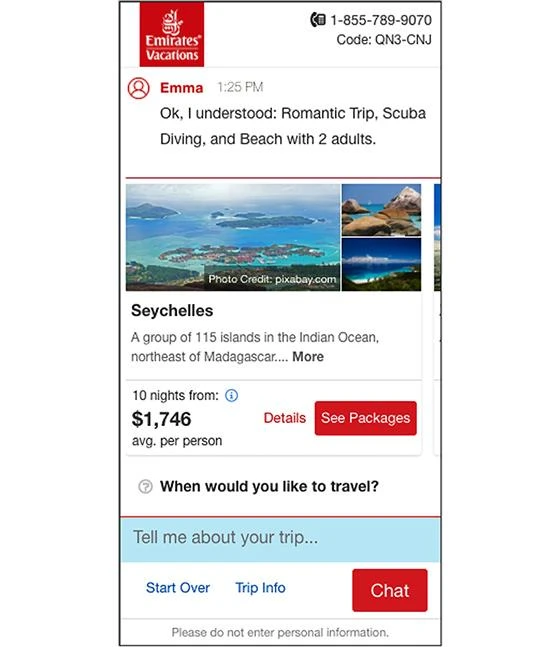
Screenshot of Emirates Vacation’s chatbot UI. Source: MediaPost
Figure 7: Screenshot of Emirates Vacation’s chatbot UI
19- KLM
KLM sends flight updates, delay alerts, and check-in reminders through Facebook Messenger. Passengers can update seat selections and meal preferences through the same channel. Customer interactions increased 40% after the bot launched, with much of the volume that previously hit the call center handled automatically.
Figure 8. A user makes a check-in via communicating with a chatbot.
Explore travel chatbot use cases and applications.
Digital assistants
20- Amazon Alexa
By 2021, Alexa supported over 80,000 skills in the U.S. alone, covering shopping, smart home control, music, polling, and third-party integrations. It remains the highest-revenue chatbot product by virtue of Amazon’s ecosystem and the scale of device shipments.
21- Google Gemini
Google Assistant is being replaced by Google Gemini across all platforms. The smart home transition, covering 800 million connected devices through the Works with Google Home program, was completed on October 1, 2025. The Android mobile replacement is rolling out through 2026. Gemini now handles restaurant suggestions, navigation, personalized news, and general queries previously routed to Assistant. Apple announced a multiyear partnership making Gemini the foundation of next-generation Siri. Any product or article referencing Google Assistant as an active platform should be updated.
22- x.ai’s Amy is already getting flowers from admirers
x.ai’s Amy scheduled over 1 million meetings by letting users CC amy@x.ai in emails; the bot handled availability matching and confirmation automatically. The company shut down in 2019. The scheduling-by-email model influenced how calendar AI tools are designed today. Current alternatives include Calendly’s AI scheduling and Copilot’s Teams calendar integration.
Legal bots
23- DoNotPay, overturns $4M worth of parking tickets for free
Stanford student Joshua Browder built DoNotPay in 2015 to contest parking tickets through a chat interface. In its first 21 months, it handled 250,000 cases and won 160,000 appeals, recovering over $4 million. It later expanded to 100+ legal processes, from college fee waivers to prison inmate communication. DoNotPay faced legal action for allegedly practicing law without a license. Current availability and legal status should be verified before citing it as an active service.
Content automation
24- Automated Insights’ Wordsmith
Wordsmith generates editorial copy from structured datasets. The Associated Press uses it to produce 4,000 earnings reports per quarter. Bodybuilding.com generates 100,000 workout recaps weekly. Greatcall generates 50,000 personalized narratives per week. Integrated into Excel, Word, and Tableau, it writes a concise verbal summary from whatever data is present. It remains one of the few publicly available APIs for natural language generation at a production scale.
25- Toutiao offers tailored news
Toutiao reached 148 million daily active users, with an average session duration of 87 minutes. Its recommendation algorithm, which also powers TikTok’s feed, learns individual content preferences through behavioral signals rather than explicit search. The Chinese government has launched multiple investigations into the algorithm’s content amplification practices, which limit the platform’s expansion outside China.
Learnings from chatbot studies
The cost-to-serve gap between bots and humans is large and growing. Retool charges approximately $3 per agent-hour. Hippocratic AI’s healthcare agent runs about $9 per hour compared to $40 for a human nurse. In banking and healthcare, bots handle queries at $0.50-$0.70 per interaction compared to $10-14 for a live agent call.
The most significant structural shift is that bots are no longer merely answering questions. Gartner projects 40% of enterprise applications will embed task-executing AI agents by the end of 2026, up from under 5% in 2025. The Availity and Slack cases in this list illustrate what that looks like in practice: the bot files code, runs scans, creates channels, and writes responses rather than waiting to be queried. 96% of IT leaders plan to expand agent use in the coming year, and half plan organization-wide rollouts.
Every successful case in this list has one thing in common: a narrow scope. XiaoIce was built to sound natural in Mandarin conversation. Wordsmith generates earnings reports. Domino’s bot takes pizza orders. The failures are consistently due to bots designed to handle everything.
FAQ
AI-powered virtual assistants utilize natural language processing (NLP) to comprehend customer intent and provide instant responses on websites, messaging apps, and social media platforms. By taking over repetitive or routine tasks, such as password resets, order status checks, and bill payments, they trim operational costs and free support teams for more complex tasks that require a human touch. The result: higher customer satisfaction scores and lower cost-per-contact, a mix that strengthens customer loyalty and overall brand reputation.
Escalate whenever a user’s customer query requires judgment, empathy, or secure intervention, for example, disputed charges, account cancellations, or emotionally charged complaints. Clear performance metrics, including confidence thresholds, sentiment triggers, and “chatbot fails” flags, help determine when human intervention is necessary. This balance ensures that customers receive swift self-service for simple issues while still enjoying the support of a human agent for situations where personal reassurance is needed.
Start by training the bot on high-quality customer data, so it recognises everyday customer interactions and delivers personalised responses in multiple languages. Involve support and marketing teams early, collect user feedback, and monitor satisfaction-rate KPIs to fine-tune prompts. Plan for seamless handoffs to live staff, and monitor business costs to demonstrate ROI. With these steps, companies, from online retailers to B2B SaaS providers, experience faster chatbot adoption, deeper customer engagement, and measurable improvements in sales and service efficiency.
Further reading
Principal Analyst

Cem Dilmegani
Principal Analyst
Cem’s work has been cited by leading global publications including Business Insider, Forbes, Washington Post, global firms like Deloitte, HPE and NGOs like World Economic Forum and supranational organizations like European Commission. You can see more reputable companies and resources that referenced AIMultiple.
Throughout his career, Cem served as a tech consultant, tech buyer and tech entrepreneur. He advised enterprises on their technology decisions at McKinsey & Company and Altman Solon for more than a decade. He also published a McKinsey report on digitalization.
He led technology strategy and procurement of a telco while reporting to the CEO. He has also led commercial growth of deep tech company Hypatos that reached a 7 digit annual recurring revenue and a 9 digit valuation from 0 within 2 years. Cem’s work in Hypatos was covered by leading technology publications like TechCrunch and Business Insider.
Cem regularly speaks at international technology conferences. He graduated from Bogazici University as a computer engineer and holds an MBA from Columbia Business School.