

Discussion and implications
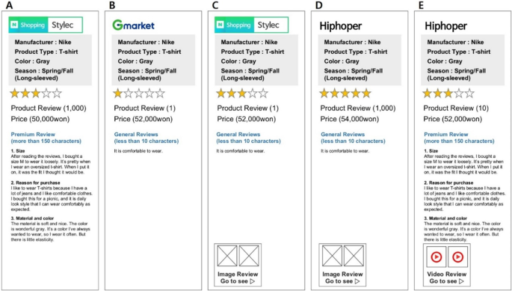
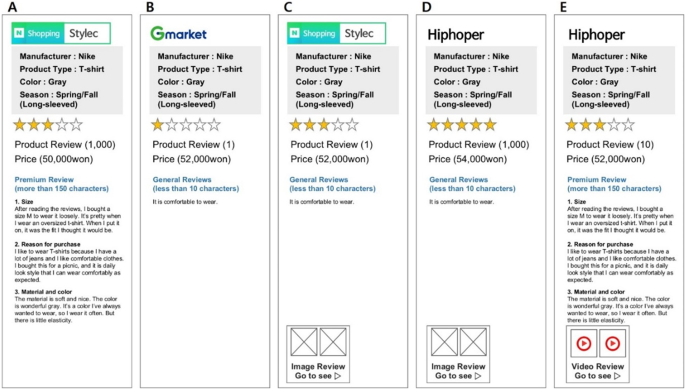
We examine six attributes related to online reviews and shopping platforms that influence consumer trust. When consumers buy experience goods online, they particularly value reviews and the type of shopping platform. Kim et al. (2012) find that trust is the most important factor in purchase decisions, which is consistent with the findings in this study; that is, reviews and shopping platforms are the most important attributes in online purchase decisions. Specifically, the most important attribute for consumers in selecting an online shopping service is star rating (RI = 28.75%; MWTP = 2655.95 KRW per star).
Premium reviews (those with more than 300 words) have a higher MWTP than of general reviews because premium reviews increase the quality of information. The lengthier the review, the more information; therefore, consumers are more interested in longer reviews and evaluate them as useful (Salehan and Kim, 2016).
The trust provided by the platform in online shopping reduces the risk created by the uncertainty consumers face regarding products and purchase decisions. E-retailer reputations exert the greatest influence on building initial trust (Sebastianelli and Tamimi, 2018). The respondents reported that when using a trustworthy shopping platform, they would be willing to pay 4446.08 KRW and 3055.26 KRW for online platforms and open markets, respectively, instead of personal shopping malls. Thus, the preference for online platforms and MWTP were significantly different versus open markets.
The majority of shopping platforms impose referral fees on sellers, with online platform fees (e.g., Naver) of approximately 5% and open market fees (e.g., Gmarket) of approximately 13%. Online platforms have the advantage of strong consumer preference and MWTP but produce lower sales commissions than open markets do. This difference has implications for building trust with consumers and increasing sales in the early stages of a product’s life. If no reviews or star ratings are posted for experience goods, it is difficult for consumers to make purchase decisions. Online shopping vendors that use a trusted shopping platform improve their chances of being selected by consumers.
Our study shows that when purchasing a nonfamous brand, consumers assign high levels of importance to star ratings, the number of reviews, premium reviews, and the type of online platform rather than the price. Interestingly, MWTP is higher when consumers are making a decision to purchase nonfamous brands than when buying famous brands across all attributes studied. In other words, consumers rely more on reviews when purchasing nonfamous brands. For example, when deciding where to buy a similar product from a nonfamous brand, consumers show a willingness to buy from a large shopping platform even if they have to pay more than they would pay for a famous brand (4931.55 KRW more versus 4446.08 KRW more). Using conjoint analysis, we identify the attributes that consumers consider to be influential in purchasing products. Keen et al. (2004) noted that the retail format (Internet, catalog, and retail) is more important than the price for a CD, which is a low-cost, low-risk product; however, price is more important for a computer, which is a high-cost, high-risk product. For low-cost, low-risk products, consumers show higher levels of MWTP at higher prices to obtain the product quickly. This result is consistent with previous findings that consumers are more willing to pay for nonfamous brands than for famous brands when purchasing products because predicting quality is difficult. Without brand awareness, it takes more effort for consumers to evaluate attributes and make decisions. Thus, reviews exert a greater impact on sales for weak brands than for strong brands.
This study provides insights into the online shopping industry and other business practitioners. Many existing studies related to trust in online shopping focus on determining the factors that influence trust, but few studies categorize and analyze the characteristics of consumer goods in detail. The results here indicate that experience goods, reviews, star ratings, and shopping platforms can increase product trust and that consumers may be willing to pay more for products of the same perceived quality. Online shopping companies in South Korea offer points/mileage to buyers who write reviews based on their experience with a given product. Online shopping sellers offer cashback, mileage, and rewards for consumers who write positive reviews, which can influence consumer purchase decisions (Duan et al. 2022). However, to the best of our knowledge, there is no data regarding the degree of importance of these reviews; thus, rewards are set based on a company’s discretion. Our results provide guidelines on the value of consumer reviews to online shopping companies across different types of shopping platforms. In the case of nonfamous brands, assessing product quality is difficult. Our results confirm that the price that consumers are willing to pay differs according to reviews and type of shopping platform for the difference between brands. A seller pays a referral fee to sell in a store on a shopping platform (e.g., Amazon or eBay). When a product of similar quality is sold on trusted shopping platforms, consumers are willing to purchase it even if the price is higher. Based on these results, online shopping companies can consider whether or not selling in a store on a shopping platform can result in higher sales, even if they have to pay a sales commission. In the case of experience goods and nonfamous brand products, we find that reviews, star ratings, and types of shopping platforms can increase product trust and serve as a basis for gaining the trust of consumers.
Limitations and suggestions for future studies
Our study has certain limitations. First, our analysis is limited to experience goods, so the generalizability of the results may be limited. Future research could be extended to other product groups, such as search goods, building on these results.
Second, due to the use of conjoint analysis, we could not apply all combinations of attributes and attribute levels. Thus, the study considered several sub-attributes based on an analysis of the existing literature and the judgment of the researchers. Moreover, conjoint analysis poses unavoidable limitations. Therefore, the attribute levels that influence trust that the study did not consider should be expanded and analyzed.
Third, to determine the MWTP, we chose clothing as our experience good, calculated the representative price by referring to actual online shopping, and conducted a survey. We verified prices through three pilot surveys and literature studies; however, the price range used and the difference between the lower and higher price ranges could be expanded. Additional research using other product groups and price ranges would provide useful information for retailers.
Fourth, despite the rapid development of online shopping, risks remain when making purchase decisions. We analyze the RI of shopping platforms, MWTP, and reviews as factors of trust that can compensate for difficulties in purchasing goods online. Naver, which was classified as a search engine in South Korea until recently, is expanding its influence on online shopping by combining search services with fees that are lower than those of other open markets. Meanwhile, Google, the leading global search engine, intends to move into the online shopping market by strengthening its shopping search function. Therefore, future studies should conduct additional research to expand the types of platforms to include global search engines and open markets.
Fifth, in the case of a discrete choice experiment, there is a possibility of attribute non-attendance or deliberate randomization. In this study, either or both may have occurred due to the cognitive effort of having to make 10 choices. However, people have substantial experience reviewing choices in the digital world, and this is a familiar subject. In addition, the deliberate subjects may not occur because we ensured that the number of attributes did not exceed seven, which is the maximum number that can be memorized; thus, excessive cognitive efforts would not be required. Further studies could aim to address this by dividing subjects into famous and nonfamous goods.
Lastly, this study presents research that can be analyzed with a mixed logit model, which is similar to existing studies. However, we used the multinomial logit model to compensate for the less favorable heterogeneity of the consumers who write the reviews. The attributes valued by consumers who write reviews differ according to the brand (or lack thereof) of experience goods sold in online shopping platforms. Therefore, considering the differences in the amount the consumers are willing to pay for each attribute is noteworthy. Researchers could re-analyze this aspect using a mixed logit model in a future study.