

Editor’s Note: After this report aired, BJC said that about 150 surgeries were rescheduled, but they were unable to provide an exact total number of surgeries impacted.
ST. LOUIS, Mo. (First Alert 4) – Healthcare workers at Barnes-Jewish Hospital are raising concerns about potentially contaminated and dirty surgical tools, and the region’s largest hospital system is confirming some surgeries have been canceled, delayed or relocated as the hospital works to resolve an instrument issue.
First Alert 4 Investigates received anonymous tips in recent weeks from whistleblowers who say they are terrified of losing their jobs but felt compelled to speak out about patient safety concerns at Barnes-Jewish Hospital.
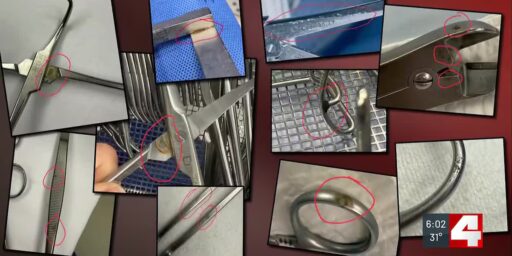
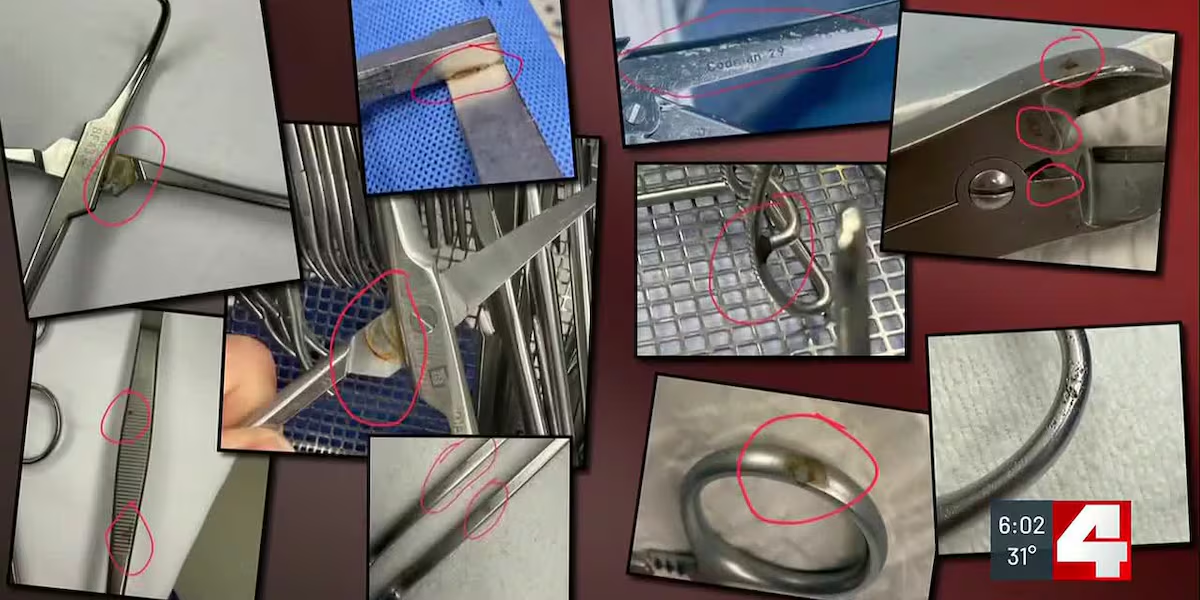
Pictures sent anonymously to First Alert 4 Investigates show brownish stains, rust, residue and damage on surgical instruments that experts say could cause infections.
Hospital acknowledges instrument shortages
One healthcare worker told First Alert 4 Investigates that it has been plain as day that some of the tools are potentially dirty or contaminated.
Barnes-Jewish Hospital representatives declined requests for an on-camera interview. In a statement, the hospital said, “Consistent with our culture of safety, during the normal pre-surgery process, our surgical teams inspect all instruments to ensure they meet our high standards. Instruments that do not meet these standards are rejected and are not used.”
But at the beginning of December, staffers told First Alert 4 Investigates that they were rejecting many instruments in a situation they say was far outside the ordinary.
“Tray after tray after tray was showing up to the OR contaminated,” one whistleblower said. “One (surgical) case went through more than 30 trays trying to find clean instruments that had supposedly gone through the sterilizer,” they said.
Staff have been instructed to use tools that appear clean to the naked eye, according to whistleblowers.
“We’re not sure if the ones that appear to be clean are actually clean,” one worker said.
The contamination issues have led to massive backlogs and delays, according to the whistleblower, with some patients transferred to other facilities. One social media post described a patient’s open-heart surgery being transferred from BJC St. Louis to Belleville after several days of waiting.
BJC Health acknowledged “isolated shortages of surgical instruments” in their statement, saying they did cancel, reschedule, delay or relocate some surgeries, adding they have addressed this with affected patients and “apologized for the inconvenience.
Expert warns of patient safety risks
Brandon Huffman, a sterile processing expert who reviewed the photos and staffers’ concerns, said the images show “systemic issues.”
“These different discolorations and bio-burden is what we would call it, and rust on instruments is a big red flag that there’s systemic issues going on,” Huffman said.
When asked if patients should be concerned, Huffman said, “Unfortunately, yes. I don’t want dirty instruments used on my family, myself, anyone for that matter.”
State investigation finds no deficiencies
Concerned staff reported the issue to the state health department, which investigated but found no deficiencies. Huffman questioned the depth of that investigation.
“So they’ll come in, they’ll ask a few questions and then they’ll leave because it’s out of their wheelhouse,” Huffman said.
The hospital system said they have “purchased additional instruments and equipment and made modifications and improvements to resolve this matter.”
We asked the state Health Department to respond to the healthcare worker’s concerns. They wrote:” If compelling information about potential regulatory violations are received, DHSS will review and investigate as needed and authorized.”
Nationwide sterile processing concerns
Huffman said sterile processing issues are becoming more prevalent nationwide as budgets are constraining and sterile processing technicians are in short supply.
“It is something that is getting worse as the budgets are constraining,” he said.
Hospitals in Colorado and Vermont paused surgeries last year over sterile tools concerns. Whistleblowers questioned why Barnes-Jewish Hospital has not done the same.
“It’s not safe and I don’t think it’s ethical,” one worker said.
BJC Health said the isolated concern affected less than 1% of their 46,000 annual surgeries, or approximately 400 surgeries. The hospital said surgery schedules are back to normal with few exceptions, and that current surgical site infection rates are in line with years past.
They repeatedly declined to say what exactly was causing the instrument shortage. The hospital system said they have “purchased additional instruments and equipment and made modifications and improvements to resolve this matter.”
First Alert 4 Investigates has requested data from the Centers for Medicare and Medicaid Services, but we are waiting to hear back.
Full BJC Health statement is below:
“At BJC Health, we are proud of our culture of safety. This culture empowers all staff members to “speak up” when they have a patient safety concern. As a result, BJC is able to provide our patients with exceptional and safe care.
Consistent with our culture of safety, during the normal pre-surgery process, our surgical teams inspect all instruments to ensure they meet our high standards. Instruments that do not meet these standards are rejected and are not used. These concerns are addressed in a timely manner, and surgical instruments deemed unfit are not used in any surgeries. We have purchased additional instruments and equipment and made modifications and improvements to resolve this matter.
Surgical instrument sterilization involves multiple processes, including cleaning, disinfection, and sterilization, as well as a rigorous inspection by multiple professionals, including nurses and surgical technicians who are trained to prepare and review all equipment prior to surgery.
Due to our rigorous reviews and processes, there have been isolated shortages of surgical instruments available. The shortage caused us to cancel, delay, reschedule, or move the location of some surgeries. We have addressed this with affected patients and families and have apologized for the inconvenience.
Our focus remains on providing excellent care for our patients in a safe environment with the support of our care teams.”
Copyright 2026 KMOV. All rights reserved.