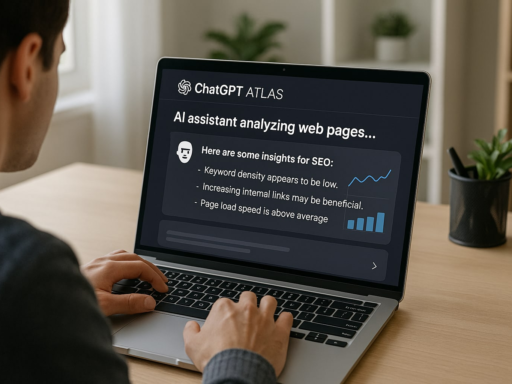



Every few months, someone sounds the alarm: “AI is going to kill SEO.”
It’s dramatic. It’s clickable. And honestly? It’s wrong.
AI isn’t replacing SEO. It’s replacing bad SEO—the kind built on shortcuts, keyword spam, and content so thin you could read through it. The mass-produced fluff that never deserved to rank in the first place.
And if we’re being honest? That’s long overdue.
SEO Has Always Rewarded What AI Now Makes Easier to Detect
Search has evolved in waves:
Phase 1: Match the keyword
Phase 2: Match the topic
Phase 3: Match the intent
Phase 4: Prove you know what you’re talking about
We’re in Phase 4 now—and AI is accelerating everything.
According to Christian Carere, founder of Digital Ducats and Director of SEO at Wexler Marketing LLC, tools like large language models don’t eliminate the need for SEO expertise. They eliminate the tolerance for SEO laziness.
Bad SEO used to slip past because no human team could manually review millions of blog posts. Now? Machine intelligence can evaluate semantic depth, topical authority, and trust signals faster than any editorial staff ever could.
AI isn’t the problem. The problem is thinking SEO froze in 2013.
What AI Is Actually Replacing
Let’s get specific. AI can generate content, sure—but it can’t manufacture expertise.
The types of SEO disappearing fall into four buckets:
1. Thin Content and Article Spinning
Remember when you could write 600 words that basically paraphrased the top result and call it a day?
AI can do that instantly now. And Google can spot it just as fast.
That game ended the moment ChatGPT went mainstream.
2. Mechanical Keyword Stuffing
Old playbook: Jam your keyword in 12 times and you’re golden.
New reality: Cover the topic comprehensively. Demonstrate you understand it. Provide something new.
AI models trained on billions of pages are exceptionally good at recognizing when content is just reshuffling existing snippets instead of solving problems.
3. Pages With Zero Expertise Signals
Google’s E-E-A-T framework (Experience, Expertise, Authoritativeness, Trust) isn’t optional anymore—it’s survival.
AI can scale generic output all day long. What it can’t replicate:
- Original research
- Field-tested advice
- Proprietary data
- Real-world photos
- Commentary grounded in actual experience
That’s why pure AI content, left unedited, gets detected and deprioritized quickly.
4. Content Farms Built for Bots, Not People
Publishing 100 mediocre articles worked when search engines didn’t have:
- AI-powered quality filters
- Advanced semantic understanding
- Entity-based ranking
- Behavioral feedback loops
Today? One deeply useful article outperforms fifteen shallow ones every time.
Where AI Elevates Good SEO
The smartest marketers aren’t asking “How do we beat AI?”
They’re asking: “How do we use AI to uncover opportunities, design better experiences, and scale what we already do well?”
Here’s where AI becomes a force multiplier—not a replacement.
Research at Scale
AI can cluster 500 related keywords into 10 intent groups in seconds. That accelerates the topical mapping stage every solid SEO strategy needs.
SERP Gap Analysis
You can ask: “What does the #1 result cover that others miss?” Suddenly you’re not just competing with the SERP—you’re surpassing it.
Expert Content Enhancement
AI can draft outlines, expand frameworks, rewrite for clarity, suggest examples, and test different tones. But it takes an expert to inject real-world context and strategic direction.
Automation Without Compromise
AI helps professionals focus on high-value work by handling:
- Schema markup generation
- FAQ extraction
- Draft social posts
- Internal link suggestions
- Competitive analysis
This isn’t replacement. It’s leverage.
The Human Element Google Keeps Rewarding
In 2025 and beyond, winning SEO revolves around information gain—the amount of genuinely new value your content brings to the table.
Humans provide what machines cannot:
- Originality
- Personal experience
- Industry nuance
- Storytelling
- Strategic judgment
- Ethical guardrails
- Context and interpretation
AI synthesizes patterns. It doesn’t create new knowledge.
Search engines know this. They’re designed to reward what AI can’t invent.
Think of AI as a Translator, Not a Creator
Here’s a useful mental shift:
AI doesn’t create value. It packages value.
If you’re a roofer, an attorney, an engineer, or a therapist, AI can help you communicate what you know at scale. That kind of SEO doesn’t die—it thrives.
The only SEO disappearing is the kind that never added real value in the first place.
How to Future-Proof Your SEO in an AI-Driven Era
Stop competing with machines. Start doing what machines can’t.
Prioritize firsthand expertise. Write (or have ghostwriters capture) real experience—not generic observations.
Publish original data. Case studies, survey results, logs, experiments. Anything proprietary moves the needle.
Think in topics, not keywords. Topical authority beats keyword density now.
Use AI to enhance, not replace.
Editing > generation
Strategizing > summarizing
Leading > following
Design for users first. Intent → answers → UX → trust → conversion → rankings. In that order.
If your content genuinely improves someone’s life, the algorithm tends to cooperate.
Final Thought
The fear that AI will replace SEO comes from misunderstanding what both actually do.
SEO matches human needs to solutions.
AI accelerates how we create and organize those solutions.
Bad SEO collapses because generative technology exposes its emptiness.
Good SEO endures because it’s rooted in expertise, empathy, and clarity—things no algorithm can fabricate.
AI isn’t here to replace SEO.
It’s here to eliminate mediocrity and reward the marketers who finally build something worth finding.