
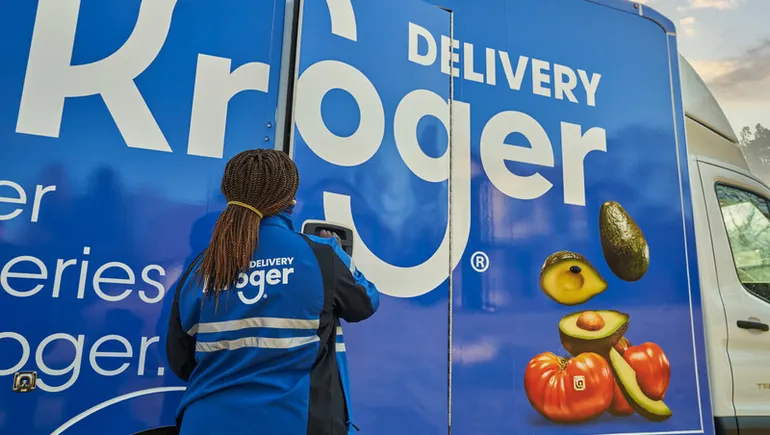
Long before Kroger launched its controversial — and ultimately unsuccessful — bid to build scale by merging with Albertsons, the supermarket chain placed another big bet on its future through its multiyear project to assemble a national network of robot-powered delivery fulfillment centers.
But while Kroger’s decision in 2018 to partner with automation specialist Ocado held the potential to put it in pole position in the grocery e-commerce sector, that initiative hasn’t been as successful as analysts had expected. Nevertheless, the retailer is still chasing its dream of transforming its digital operations into a profit engine.
Kroger’s e-commerce business has been growing at a rapid clip in recent quarters, with online sales serving as the company’s growth engine. Online sales during the grocer’s first quarter were up 15% year over year, led by delivery — which has been driving growth across the grocery e-commerce sector for the past couple of years — Kroger interim CEO Ron Sargent said June 20 during the company’s earnings call.
Despite that, Kroger faces substantial obstacles as it works to continue improving its online operations — including competition from Walmart, which turned a profit with its e-commerce business for the first time during its most recent quarter — according to industry analysts.
Focusing on efficiency
Kroger has taken steps to deliver orders faster and more accurately in addition to shaving wait times for shoppers who pick up orders, Sargent said.
“These improvements are attracting new households to e-commerce and giving our current households more reasons to shop with us. As our e-commerce business grows, it represents a bigger impact on our results,” Sargent said.
In addition, Kroger earlier this year formed a new business unit that encompasses all of its e-commerce activities. The group “will center on deploying new technology, improving density in our fulfillment operations and accelerating the growth of our retail media platform,” Kroger CFO David Kennerley said during the earnings call.
Kroger is embarking on “a comprehensive review of our e-commerce operations and reviewing all aspects of the business to drive growth by improving the customer experience, while improving profitability,” Kennerley added.
Although Kroger’s e-commerce business achieved its “best profit improvement yet” on a quarterly basis during the first three months of its current fiscal year, the company is still not making money online — but is determined to change that, Sargent said.
“I think we have a terrific foundation in place in our e-commerce business, and we have invested heavily in our e-commerce business over the last several years,” Sargent told investors. “We are, I think, offering a better customer experience.”
Kroger is pressing ahead with efforts to turn its online sector into a moneymaker as the company looks to reduce its expenses and refocus its priorities against a backdrop of intense competition from retailers like Walmart, Costco and Amazon, all of which command powerful positions in the grocery industry. The company’s broad-based cost-cutting initiative includes closing dozens of stores, investing in lower prices and increasing staffing levels in stores, Kennerley said.
Stiff challenges lie ahead
Walmart’s ability to achieve profitability online reflects its prowess in automation and retail media, and puts pressure on rivals like Kroger to follow suit as they look to thrive in an increasingly omnichannel retail environment, analysts said.
Kroger has a difficult balancing act on its hands as it looks to save money, improve its value proposition to consumers and find ways to turn a profit online, said Scott Mushkin, CEO of R5 Capital. In particular, the company faces the challenge of trying to keep pace in e-commerce with Walmart, which has invested heavily in automation and is seeing better growth in its store-level business than Kroger, Mushkin said.
Kroger may “want to be more disciplined with their capital structure … but they may be forced to invest much more aggressively in distribution automation,” he said.
A key advantage Walmart enjoys is that it has a truly national store footprint that allows it to quickly fulfill online grocery orders, said Michael Infranco, assistant vice president of RetailStat. Kroger would have gained that kind of coverage if it had been able to combine with Albertsons, but instead finds itself looking for other ways to improve its e-commerce presence, Infranco added.
“I think the big difference so far is that Walmart has done a better job of leveraging its entire infrastructure,” he said. “And I think that’s a significant advantage.”
Infranco added that he thinks Kroger lost ground in its effort to become more agile online because it was distracted by the merger and has also not been able to capitalize fully on its investments in the Ocado network.
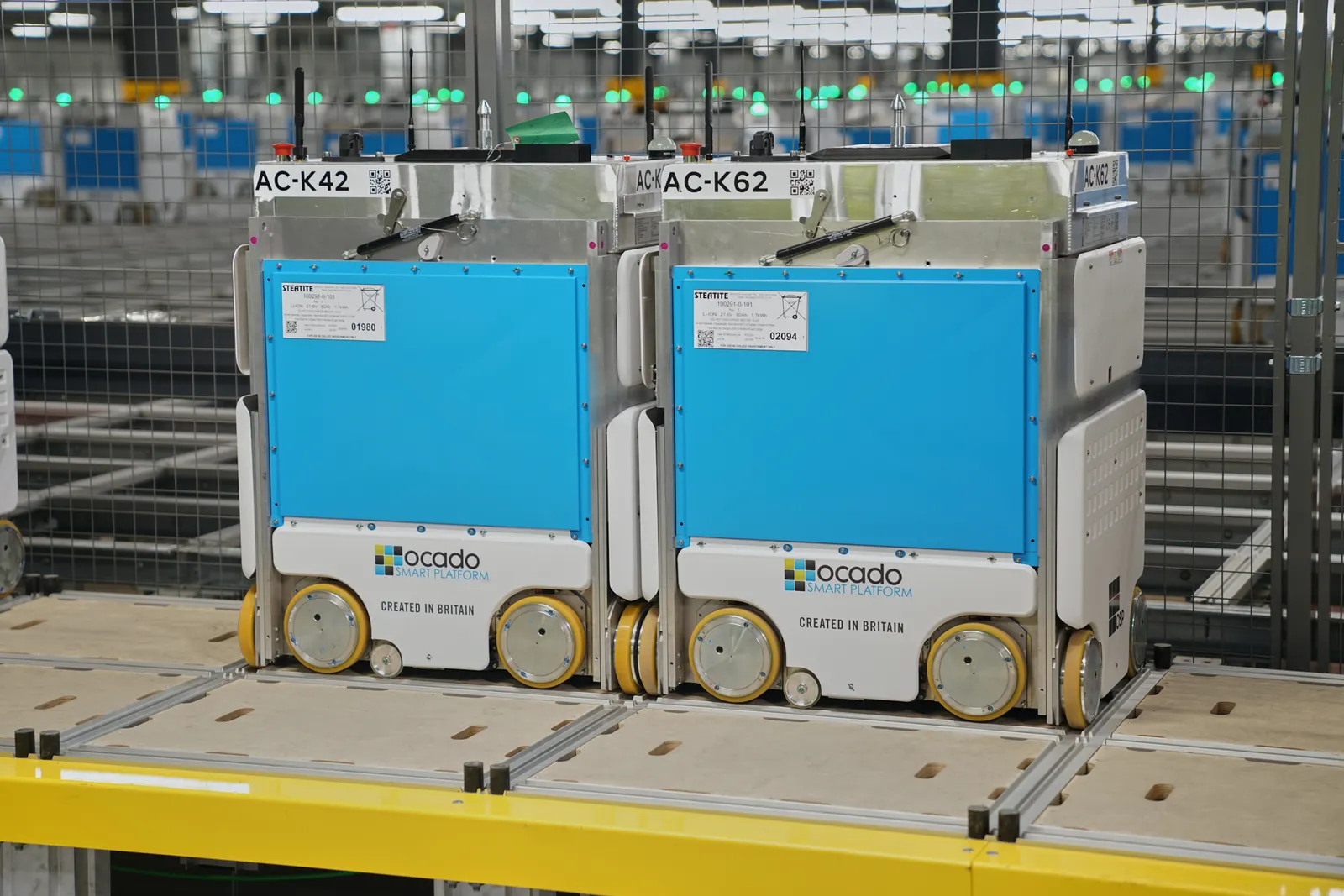
Ocado robots in an automated warehouse.
Permission granted by Kroger
Kroger’s rollout of automated warehouses and supporting infrastructure through its partnership with Ocado has stalled after moving ahead briskly between 2020 and 2022. The company did not open any of the automated facilities, known as customer fulfillment centers, in 2024. Also last year, Kroger said it would close three facilities linked to warehouses in the network.
“I really thought that Kroger’s aspiration was to be a national grocery delivery organization. That’s what it seemed that Ocado could provide to them, and that really hasn’t seemed to come to fruition,” said Infranco.
The fact that Kroger’s newly appointed CFO and interim CEO have quickly zeroed in on the need to find ways to bring the company’s digital operations into the black reflects the urgency for Kroger to achieve that, said Arun Sundaram, senior vice president of equity research for CFRA Research.
Sundaram noted that the key for retailers intent on making their e-commerce businesses profitable is to focus on their retail media and advertising operations, which offer higher margins than selling groceries. He pointed out, however, that while Kroger has a solid foothold in those areas, it faces increasing competition from other grocers that have stepped up their data-focused activities. In addition, spending on advertising by food companies has lagged, Sundaram said.
“They’re going to need that business to ramp back up if they want to improve e-commerce profit margins,” he said.