
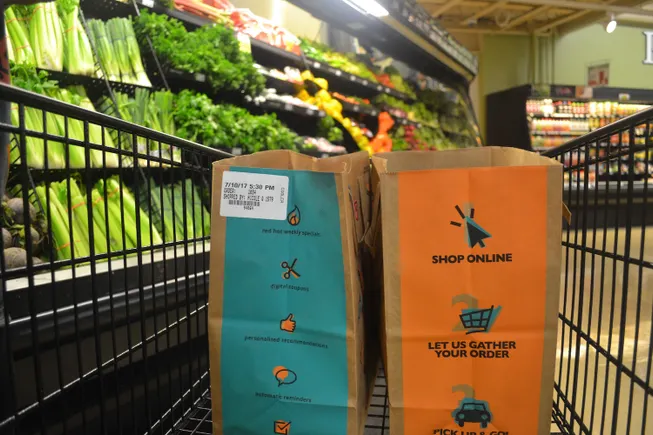
The explosive growth in demand for online grocery shopping services driven by the coronavirus is poised to redefine the supermarket business’ approach to e-commerce, according to industry consultants.
“I think we’re going to look back at this time where there was an acceleration of an already existing trend towards online ordering,” Jaron Waldman, CEO of Rakuten Ready, a company that helps grocery stores and restaurants manage their pickup operations, said in an interview. “The grocers that do the best job of managing the surge in demand for online ordering are going to come out of the crisis looking better.”
A central issue for grocers is how they use their store aisles and backrooms to fill orders for pickup or delivery, said Neil Stern, senior partner at McMillanDoolittle, a retail strategy and consulting firm. Stern has worked with grocers including Publix, Harris Teeter and Kroger.
Depending on retail floors to fill orders “is terrible for a pick-and-pack operation, where you have 50,000 SKUs spread across 40,000 square feet,” Stern said. “The [store-centric] model doesn’t scale, and that’s what we’re learning from what’s happening right now.”
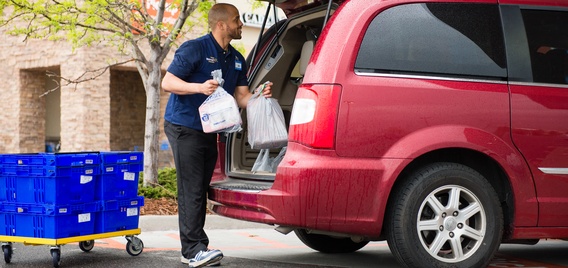
Photo courtesy of Walmart
The problems inherent in that strategy raced into public view as the pandemic began its grip on American society, sending panicked shoppers into stores to compete with a torrent of workers trying to fill online orders, he said. Retailers were overwhelmed by the surge, pushing back fulfillment times by days and even weeks and causing some services to shut down temporarily. According to Brick Meets Click, nearly one-third of U.S. households shopped for groceries online in March, and sales ballooned even higher in April.
“What this really does is it exposes the vulnerability of online grocery in the United States,” Stern told Grocery Dive. “The vast majority of products are picked in-store, and that is the least efficient and least reliable way to get products to consumers.”
Predictions that had called online shopping to grow over the next five or six years to between 10 and 15% of the industry’s overall revenue are now in question, Stern said. Instead, the industry could see online sales spike to 25% of grocery spending in the United States in just a couple of years, he projected.
“There’s no way we have the capacity in the system to handle that today,” Stern said.
Diana Medina, director of e-commerce solutions at Inmar Intelligence, said many independent retailers that didn’t formerly have e-commerce platforms are scrambling to get online. One of the biggest challenges they’re facing is re-configuring their stores for order picking and packing.
“You have to have some dedicated space in the store to stage your orders, to have your orders ready for when the customer picks them up,” Medina, who formerly worked for Lowes Foods, told Grocery Dive.
Another key challenge for grocers reliant on store fulfillment is that it’s difficult to provide accurate information about what is in stock when a customer places an order, said David Bishop, partner at Brick Meets Click. That problem is especially acute now, as grocers struggle to meet unprecedented demand for groceries caused by the pandemic, he said.
With people long accustomed to knowing immediately whether something they want to buy online is available to ship, finding out that a product they want from a supermarket is sold out only when a worker is in a store aisle fulfilling their order can be jarring, he said.
“All the technical stuff that goes on behind the scenes [to] sync online ordering systems with in-store inventories all fall by the wayside to a customer,” Bishop said. “The customer just says, ‘If it’s not available, then tell me it’s not available.”
“The vast majority of products are picked in-store, and that is the least efficient and least reliable way to get products to consumers.”

Neil Stern
Senior partner, McMillanDoolittle
Revising stores, investing in automation
Pre-pandemic, retailers were beginning to test automated fulfillment systems that can bring down the cost of picking orders and ramp up speed. Now, they’re looking to bring these systems online even faster.
Technology firms like Dematic, Alert Innovations and Takeoff Technologies have entered into pilot programs with retailers like Walmart and Albertsons. Curt Avallone, chief business officer with Takeoff recently told The Spoon that the firm is getting more orders from grocers for its micro-fulfillment centers, which are currently filling orders 80% to 100% above average. The firm is seeing interest in standalone facilities as well as those that can bolt on to retailers’ existing stores.
Meanwhile, Kroger and British e-grocer Ocado continue to build large automated sheds that can fulfill mass quantities of orders. Kroger CEO Rodney McMullen said during a recent fireside chat with Evercore ISI that the investment is looking particularly favorable for the grocer nowadays, with the online demand curve accelerating ahead of schedule. The companies’ first shed will open next year in Monroe, Ohio.
But grocers may not need to race out and spend millions on robotics systems. In the near-term, stores can take relatively simple steps like offering various delivery options to relieve pressure on employees and align the service they can provide with what consumers sign up for, Bishop said. For example, a store could allow customers to save money by selecting a broad delivery window the day after they place an order, or pay a premium for same-day service in a narrow time frame, he said.
Dedicating store space or converting underperforming real estate to a dark store operation, where dedicated staff picks items arranged for maximum efficiency, can also significantly boost fulfillment capabilities, said Scott DeGraeve, COO and co-founder of Locai Solutions, which provides e-commerce technology to the supermarket industry. Before the pandemic struck, Whole Foods Market transformed in-store cafes at stores in Berkley, California and Philadelphia into dedicated staging areas for online orders. The specialty grocer, along with Kroger, Giant Eagle, Stop & Shop and a handful of independents, has also converted select stores to pickup and delivery fulfillment only as pandemic-fueled online sales have soared.
“Over the next 12 months we’re going to start seeing a significant increase” in the transformation of supermarkets into hybrid facilities that separate online and in-store shopping operations, DeGraeve said. “The speed at which you can roll these [changes] out is going to get significantly faster as well, so over the next 12 to 24 months, I think we’re going to see a major shift, with a lot of retailers moving some portion of their store infrastructure into this type of dedicated fulfillment approach.”
Dedicating 5,000 to 10,000 square feet to fulfillment can yield a host of benefits to grocers, particularly if it includes some degree of automation, Stern said. A human grocery picker operating inside a traditional supermarket can select between 20 and 30 individual items per hour, while robot-based systems can pull together as many as 350 items in that amount of time, he said.
Beyond speed and efficiency, in-store fulfillment centers could eventually become a retail theater for shoppers, DeGraeve said. Locai along with Alert Innovations, which provides micro-fulfillment technology for Walmart, have developed future-store concepts that place automated fulfillment of grocery products at the center of the store. People who shop in stores equipped with automated facilities could order basic items like milk and cereal at a kiosk, then personally select foods like produce and deli items that shoppers are especially fond of choosing themselves, DeGraeve said.
“I think there can even be a little bit of theater associated with it,” DeGraeve said. “You could go on the mezzanine, sit in a coffee shop and watch the robotics pick your order while you wait.”
Jeff Wells contributed reporting to this story.