



HIGH POINT — The task of reaching customers where they are and enabling them to shop how they want to shop is a constantly moving target for furniture retailers.
Consumer preferences and spending habits change, as do macroeconomic factors such as inflation and spending power. Breaking through to customers requires keeping close tabs on how they are behaving in response to these conditions.
BigCommerce — an ecommerce platform whose customers in the home furnishings space include Burrow and American Leather — recently released a report that sheds light on where and how today’s consumers are shopping for furniture.
The report, titled “The Omnichannel Customer Journey: The New Buyer Experience for Home Furnishings Shoppers,” surveyed more than 3,000 U.S. consumers to explore their shopping habits and preferences.
Online or in-store: Why not both?
The most surprising topline finding is that both brick-and-mortar and the online storefront have traction among consumers, who prefer a mix of online and in-store shopping experiences.
According to the report, 48% of respondents still prefer to purchase home furnishings in-store, while 28% favor online shopping. Still, more than 60% of consumers use digital touchpoints, such as home decor websites and social media, for inspiration. Platforms such as Instagram and TikTok have become influential in the process of product discovery, with 48% of respondents citing social media as a primary source.
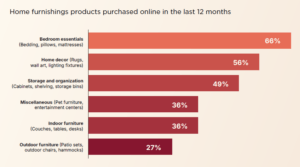
The types of home products that customers were gravitating toward is another interesting finding. E-commerce consumers showed a strong preference for bedroom and décor, which 66% and 56% of respondents reported having purchased online in the last month.
Larger living room items and outdoor furniture showed a decided slant toward in-store purchases, with only 36% and 27%of respondents, respectively, saying they had purchased these online in the last year.
Online marketplaces including Amazon and eBay, along with big-box store websites such as Walmart and Target, are the top browsing channels for 64% of consumers due to their wide selection and trusted reputation.
Online marketplaces and big-box store websites are the preferred choice for 54% of consumers purchasing mid-priced home furnishings ($100–$499), surpassing direct brand websites (39%). Features such as big-box promotions and Amazon’s free two-day shipping may drive this preference. To stay competitive, brands should list mid-priced items, such as rugs and coffee tables, on these popular platforms and enhance their own website offerings.
The report also revealed an appetite for visualization technologies among online consumers. It found that 47% of shoppers feel more confident in their purchasing decisions when using tools like virtual showrooms or augmented reality (AR) displays to visualize products in their homes.
Although only 27% of respondents have used these technologies, their potential to enhance the shopping experience shows clearly in the report’s findings.
Other key findings
Buy-online-pick-up-in-store has also become an expectation rather than a convenience, with 69% of respondents using it in the past year. Notably, 80% of these shoppers reported purchasing additional items when picking up orders.
Sustainability remains important to consumers, but cost is still a barrier. While many respondents expressed interest in energy-efficient products and sustainable packaging, the majority were unwilling to pay more than 10% extra for eco-friendly options.
The report underscores the importance of promotions in influencing shopping behavior. Eighty-two percent of in-store shoppers are willing to buy online if presented with an online-only promotion, while 76% of online shoppers would consider switching to in-store purchases for exclusive deals.
Easy and free returns are another crucial unlock for a majority of consumers. Over 60% of respondents said they are more likely to purchase from an online brand that offers free return shipping.
“Today’s home furnishings shoppers are more informed and selective than ever, blending in-store and online experiences to make confident purchase decisions,” said Melissa Dixon, director of brand and content marketing at BigCommerce.
“These findings highlight the importance of a robust omnichannel strategy, complete with flexible payment options and highly personalized customer engagement — key drivers not only for boosting sales but also for fostering deep, long-term brand loyalty.”
The full report can be downloaded here.
See also: