
In the past 10 years, the framework of best online digital marketing courses has undergone immense changes, with businesses of all sizes attempting to woo their audiences through various strategies. As consumer behavior is shifting toward online ways of interaction, understanding the future demand for each type of digital marketing is crucial for every aspirant in the field or for any business wanting to stay in the competition of types of digital marketing.
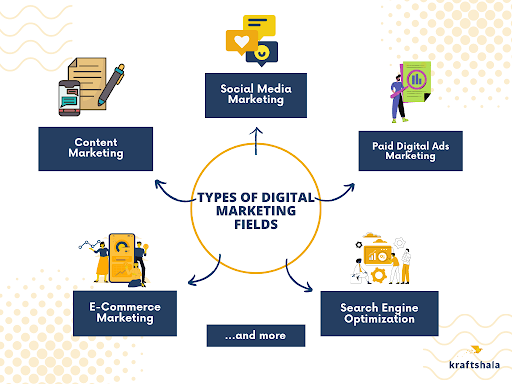
Kraftshala
1. Search Engine Optimization (SEO)
This type of digital marketing goal of SEO is to prepare the content to be placed well within the search engine results page, more commonly known as the SERP, done by search engines like Google is the best type of digital marketing.
Google ranks a page on the amount of relevance with the keywords that are searched for by the user using algorithms. These algorithms change frequently, so SEO strategies must constantly evolve to remain useful.
When good, an SEO effort will elevate your site toward the top of the SERP and bring in more organic traffic.
| Pros | Cons |
|---|---|
| 1. It increases brand visibility. | 1. SEO is dependent upon content and tech. |
| 2. It is cost-effective in comparison to PPC. | 2. Ever-changing algorithms of Google may hinder your work. |
| 3. It takes time to see results. |
The next steps:
- SEO begins with content creation. Following a good content strategy, perform keyword research and find out what people search for.
- Keep up-to-date with Google’s advice on content.
- A beginner would tend to use a plug-in to help optimize their site (e.g., Yoast for WordPress).
2. Pay-Per-Click Advertising (PPC)
On search engine marketing an SEM is undertaking paid advertisements that are positioned on top of the SERP. An advertisement’s cost is usually based on the number of clicks the link receives, thus “pay-per-click.” is the type of digital marketing.
Whenever payment is made for the slot at the top of the SERP, an “Ad” label placed next to the URL is assigned. Though consumers know that these are ads, they still click on them quite a bit, and this is the best online digital marketing course strategy.
| Pros | Cons |
|---|---|
| 1. It helps achieve ranking in a very short time. | 1. Keyword targeting becomes expensive, especially for competitive terms. |
| 2. Easy on time factor. | 2. There is a wide mistrust of ads appearing in search results, with a greater trust given to those appearing in natural search. |
What Next:
You can use PPC to generate more leads. Conduct your keyword research and experiment with different targeting combinations to see what works best as the type of digital marketing.
3. Social Media Marketing (SMM)
Social media platforms are one of the best online digital marketing course channels nowadays with social media marketing. Ads are being purchased to reach out to new audiences, or one can even set up a business profile on any social media platform to market new products, sales, or fresh content via posting.
It depends on the type of audience you want to reach as to what social media platform you will use. For example, while Instagram does the best job of reaching audiences between the ages of 25 to 29, it would seem that for audiences of 65+, Facebook would do a better job.
| Pros | Cons |
|---|---|
| 1. Conversions happening at a greater scale. | 1. Social media is dynamic. The algorithms keep changing from time to time. Newer formats for creating fresh content keep being introduced. |
| 2. Your efforts multiply as people like, comment, and share your content. | 2. It sounds easy to put something on social media, but strategic planning skills and sufficient time dedication are required for efficient and consistent posting. |
| 3. Facebook/Instagram ads allow you to target specific customer segments and address your message to the right audience. |
Next Steps:
Create a calendar for this marketing tactic, one where you can mark the days for each channel’s posting. Social media, being an interactive platform, also demands good customer feedback, in addition to posting stellar content. Real conversations can build trust, and trust builds brand loyalty.
4. Content Marketing
Content marketing is all about providing value type of digital marketing through informative, sometimes entertaining, content, such as blog posts, how-to videos, and other forms of teaching material. It connects you with your audience and addresses their concerns. It brings in leads and helps close sales.
Content distribution should be done consistently, with your audience in mind. In a perfect world, with expertly written, reliable content, your brand would have established itself as a prominent, trustworthy voice in its industry. You want your audience to trust you first above anything else for the latest information about industry issues.
| Pros | Cons |
|---|---|
| 1. It’s free. | 1. High competition; takes quite a while to organically rank for target keywords. |
| 2. Extremely flexible media. Build your brand by educating, entertaining, and inspiring audiences. | 2. Consistency and quality are the keys here. Your content must satisfy the needs of your customers while branding and achieving your business goals. |
| 3. Fuels all other best online digital marketing course methods. |
Next Steps:
-
- Design a basic content marketing strategy.
- Pick 4 to 5 core themes that address customer needs and what your brand wants to tell to the outside world.
- Choose the formats: video, audio, article, or others.
- Decide the channels on which you will deploy every piece of content.
5. Email Marketing
When someone visits your website or business, invite them to join an email subscriber list. With their permission, you can send emails about sales, special events, or product releases. Email marketing is often underestimated, and according to Lyfe Marketing, approximately $40 of revenue is brought in for every dollar spent on email marketing.
The most important part of this best online digital marketing course channel is that it should provide value to your audience. Offer them exclusives that they would not receive anywhere else, and you can build a mutually beneficial relationship that will increase brand loyalty.
| Pros | Cons |
|---|---|
| 1. Amongst several types of digital marketing, this one is independent of any changing algorithms. | 1. Often customers do not open emails. |
| 2. Staying constantly in contact with your email list allows you to strengthen relationships, and they are likely to keep you in their minds when they plan to buy. | 2. It gets difficult to find ways to add value so that the customers do not unsubscribe. |
The Next Steps:
- Select an email software such as ConvertKit, GetResponse, or Mailchimp.
- Collect your target customer’s emails.
- Give them a reason to opt for your emails, such as offering step-by-step PDF guides and free design templates.
- Pay attention to the regulations.
- Maintain consistency and contact your list regularly via the weekly newsletter. Add value to your content rather than just the promotions and sales messages.
6. Affiliate Marketing
Working with an affiliate or an influencer may extend your audience reach by channeling engagement with their existing audience. For the partnership to work effectively, try to select a person who is well-known in your industry and respected.
The person would be able to generate content promoting your business or product and provide a link to your website. With every completed sale or link click, the influencer/affiliate receives a kickback.
| Pros | Cons |
|---|---|
| 1. You are given the influencer’s audience, so you need not build one yourself. | 1. Not just paying a high amount to partner with influencers, you have to choose the right influencer for your audience and brand and go about it in ways that are real for them. |
| 2. Associated with a popular person, you earn genuine followers and customers. | 2. Distrust in influencers is rising, so think carefully and be transparent about paying them for promotions. |
The Next Steps:
- Determine and document your expectations for an influencer marketing campaign. Create a list of potential influencers that look like a good match for your brand, approach them, and negotiate the terms considering theirs.
7. Mobile Marketing
As per Google research, 27% of people worldwide use mobile voice search. The mobile consumer journey is on an exponential rise. The best Online Digital marketing courses require immediacy as much as loyalty, and smartphones are one of the most immediate problem-solving partners anywhere, anytime.
Mobile marketing is mandatory for brands who desire to be with their customers, side by side. It requires the marketer to adapt everything he is doing on the desktop to mobile. You must also be efficient in mobile-specific tasks such as in-app advertising, texting, and social messaging apps. It is significantly important for brands that target a younger audience.
| Pros | Cons |
|---|---|
| 1. Customers spend more time on mobile phones than on their desktops/laptops these days. So, mobile marketing helps in reaching where they spend most of their time. | 1. The space is small compared to computers. |
| 2. It can be super-targeted with geo-fencing or specific audience segments. | 2. Mobile ads have a low click rate. |
| 3. People often dislike interruptions by marketing messages when they are communicating. |
The Next Steps:
- Optimizing your website and content for mobile is a prerequisite. It must work and look good on all devices. You can create an app, adopt instant messenger marketing, and offer services by geolocalization. Some quick tips for your next step are:
- Keep things simple and short.
- Use clear text and big buttons.
- Put captions on your videos to convey your message to people who have the sound system muted.
8. Online Public Relations (PR)
This includes the online management of PR and image. This includes social media monitoring, customer response management, and other proactive activities for establishing a positive online reputation. A good online PR strategy can help a business earn respect, speak confidence to its customers, and desensitize any triggers of negative reviews or incidents.
9. Video Marketing
Today, short and snappy video content is way quicker than text in catching the attention of consumers. Be it educational or entertaining, live or pre-recorded, video is the best online digital marketing course tool. Two billion people look up something on YouTube every month. That’s a great window to gain new customers, with video marketing strategies yielding results across the marketing funnel.
80% of customers will use search engines and videos to learn about a product and check for reviews, while 55% will do this before purchasing.
| Pros | Cons |
|---|---|
| 1. Video can form an emotional connection with the masses and efficiently communicate your message. | 1. It becomes difficult to catch the viewers’ attention in mere seconds. Quickly, users skip to the next content on their feed. |
| 2. Videos are remembered better than texts or images. | 2. Preparing quality video content requires time, resources, and expertise. |
| 3. Video content has become an important focus of Facebook, Instagram, and LinkedIn alike to improve reach and engagement and would, consequently, rank higher in search results. |
10. Chatbot Marketing
Chatbots can answer inquiries, provide information, and guide users through the sales funnel. Several advantages of digital marketing and disadvantages accrue to this marketing tool depending on how well it fits into a business’s goals and customer expectations. The following are some advantages of digital marketing and disadvantages of chatbot marketing:
| Pros | Cons |
|---|---|
| 1. Available 24/7: Since chatbots can provide their services to customers anytime and anywhere, they are the latest customer engagement channels, thereby improving customer satisfaction and engagement beyond business hours. | 1. No Empathy: Chatbots lack the human touch and emotional sensitivity that a human customer service agent brings to the table. In such cases that depend on empathy or deal with sensitive issues, that could act to their disadvantage. |
| 2. Cost-Efficient: Deployment of chatbots is more cost-effective than employing additional customer support staff. | 2. Learning Curve: Building and optimizing a chatbot calls for technical skills and time. Training a chatbot to comprehend different scenarios and responses may prove an uphill task. |
| 3. Efficiency and Speed: Chatbots answer and solve inquiries in real time, minimizing users’ waiting time. | 3. Tech-Dependent: Chatbot marketing is tech-dependent, and if by any chance the technology goes bad or glitches, it may, in turn, lead to unwanted experiences and antagonizing user experience. |
| 4. Consistency: Chatbots are more consistent in their responses and information than humans, and thus have eliminated the possibility of human error in communication. |